
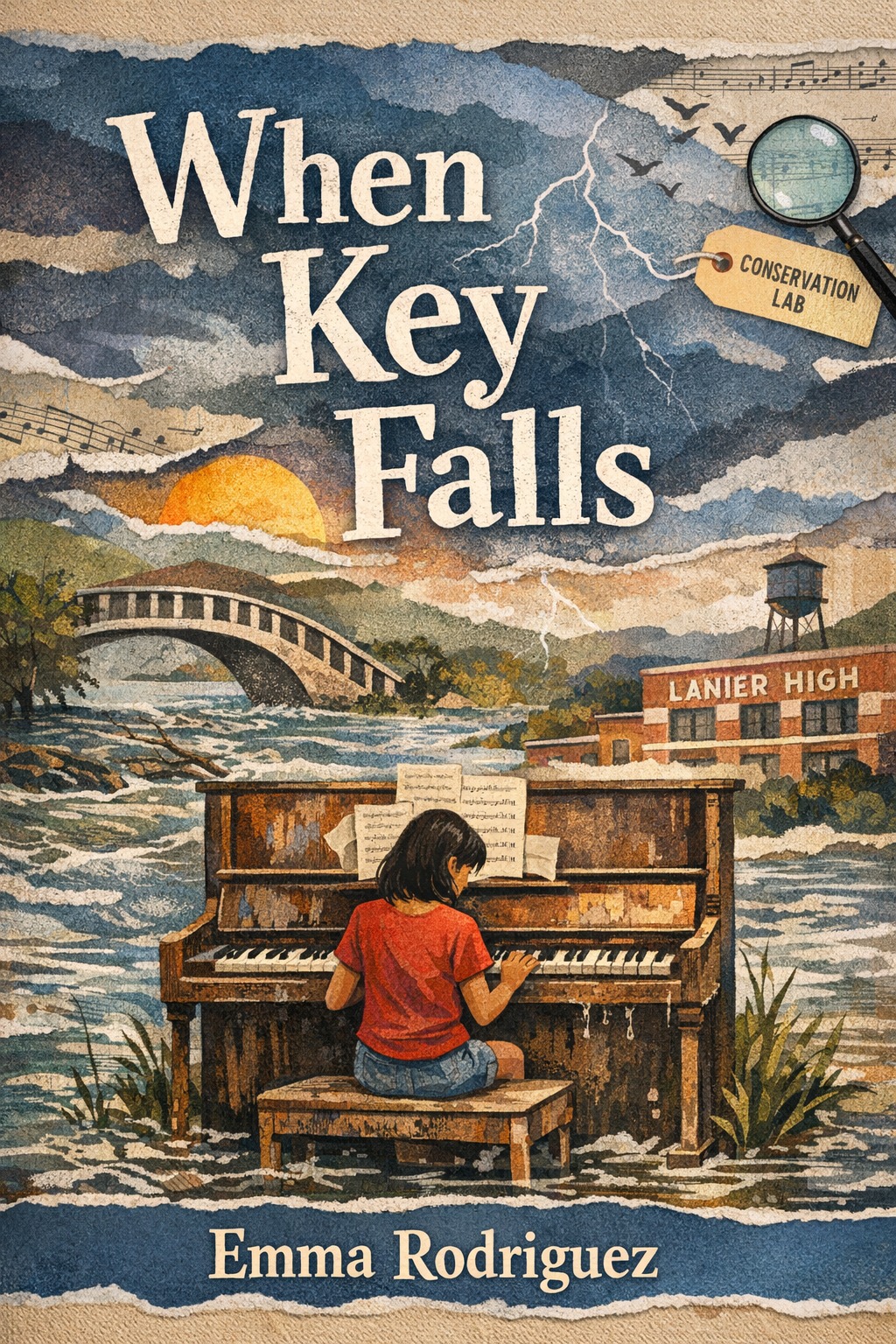
Cover of When Key Falls

When Key Falls

Graphic Novels · 208 pages · Published 2025-10-15 · Avg 4.0★ (6 reviews)

In the summer after a rare Hill Country storm swelled the San Antonio River, sixteen-year-old pianist Inez Delgado finds a waterlogged Baldwin upright in the shuttered gym of the Guadalupe Community Center. When a traveling conservation lab sets up in a borrowed classroom at Lanier High, Inez signs on to sweep and sort, and meets Javier Camacho, a soft-spoken museum conservator on loan from the Smithsonian who specializes in keyboard instruments. Over smudged pencil diagrams and tape-labeled jars of hide glue, friendship forms in the hiss of dehumidifiers and the measured click of center pins. Inez is all edge and worry, practicing scales on a plastic Casio in her family’s apartment off Culebra Road; Javier carries a careful calm and a past he rarely names. The first key they coax loose—an E with its cap missing—falls into Inez’s palm like a secret.

Drawn in ink washes and annotated with field notes, When Key Falls follows their weeks of small repairs: steaming loose veneer with an iron borrowed from a tía, re-felting hammers at a workbench built from pallet wood, mapping flood lines against sheet music for Debussy and Lydia Mendoza. Panels move from the cool back rooms of the Majestic Theatre to Sunday Mass rehearsals on the West Side, from a Laredo flea market where spare ivories surface to a quiet phone call to a mentor in Monterrey. As the piano comes back, Inez learns to hear what’s beneath the noise—her own timing, chosen family, and the way making can be a kind of care. The book closes with a community recital under box fans and papel picado, a chorus of neighbors and cicadas rising as the repaired keys hold, one note after another.

Rodriguez, Emma (b. 1986) is a journalist and biographer from San Antonio, Texas, based in Brooklyn. A graduate of the University of Texas at Austin and Columbia Journalism School, she has profiled artists, scientists, and museum conservators for outlets including Smithsonian, Texas Monthly, and the Los Angeles Review of Books. Her previous biography, The Quiet Frame, explored photographer Celia Navarro's borderland work and was named a best nonfiction title of the year by several regional newspapers. Rodriguez has held residencies at MacDowell and Ucross and teaches narrative nonfiction at CUNY's Craig Newmark Graduate School of Journalism.

Ratings & Reviews

Geraldine Soto
2026-04-01

Recommended for teens who crave process, quiet stakes, and the satisfaction of making something work. Good for music students, woodshop and art classes, and readers who enjoy slice-of-life graphic narratives rooted in community repair culture.

Ages 14+. Content notes include flood aftermath, church settings, long hours of careful manual work, and mild family stress. Tone stays gentle and affirming.

Hannah K. Liao
2026-03-10
  • Gorgeous repair minutiae and ambient sound design
  • San Antonio textures feel lived in
  • Momentum drifts in the middle, with scenes that circle the same emotional note
Royce Patel
2026-01-22

As a world, the book is a workshop you can smell and hear, with dehumidifiers ticking, center pins clicked back into tolerance, and hide glue warmed in jars with tape labels. San Antonio's West Side, the Majestic's cool corridors, a Laredo swap meet, and a borrowed classroom at Lanier become waypoints in a map of repair, and the process lore is generous without turning didactic. A tiny wish for a glossary aside, it is transportive and precise.

Lucía Robledo
2025-12-05

Inez es filo y nervio, pero la vemos aprender a respirar a través del trabajo, y Javier aporta esa calma rigurosa que no borra su historia, solo la sostiene. Sus conversaciones son bajas y precisas, más miradas que discursos, y cuando hablan de teclas, en realidad abren espacio para hablar de tiempo, familia elegida y cuidado.

Quise quedarme más tiempo con ellos en el taller.

Trent McAllister
2025-11-15

The composition is meticulous without feeling sterile, using gray-blue washes and annotated margins to stage a repair diary that doubles as coming-of-age. Page turns are paced like a metronome, shifting from lab bench to sanctuary to theater storerooms with clear visual cues; a few mid-book spreads blur into each other, but the closing sequence gathers the threads with satisfying clarity.

Maya Coronado
2025-10-20

What a luminous hush this book keeps. Ink washes pool like late light on tile, and every panel seems to breathe with patience and intent.

Inez and Javier tune not just a Baldwin but a way of being, listening for soft clicks and offbeat courage among jars of hide glue and hand-sketched diagrams.

I cried when the first key landed in Inez's palm.

Community threads everywhere: a tía's iron steaming loose veneer, back rooms at the Majestic, Sunday rehearsal air that smells like floor polish, a flea market table where spare ivories seem to remember songs.

Across flood lines mapped against Debussy and Lydia Mendoza, the book whispers and then insists that "making can be a kind of care" and that chosen family is a practice, not a promise.

By the time box fans hum under papel picado and cicadas rise, I felt seen, steadied, and hungry to pick up a tool and listen.

Generated on 2026-04-02 12:03 UTC