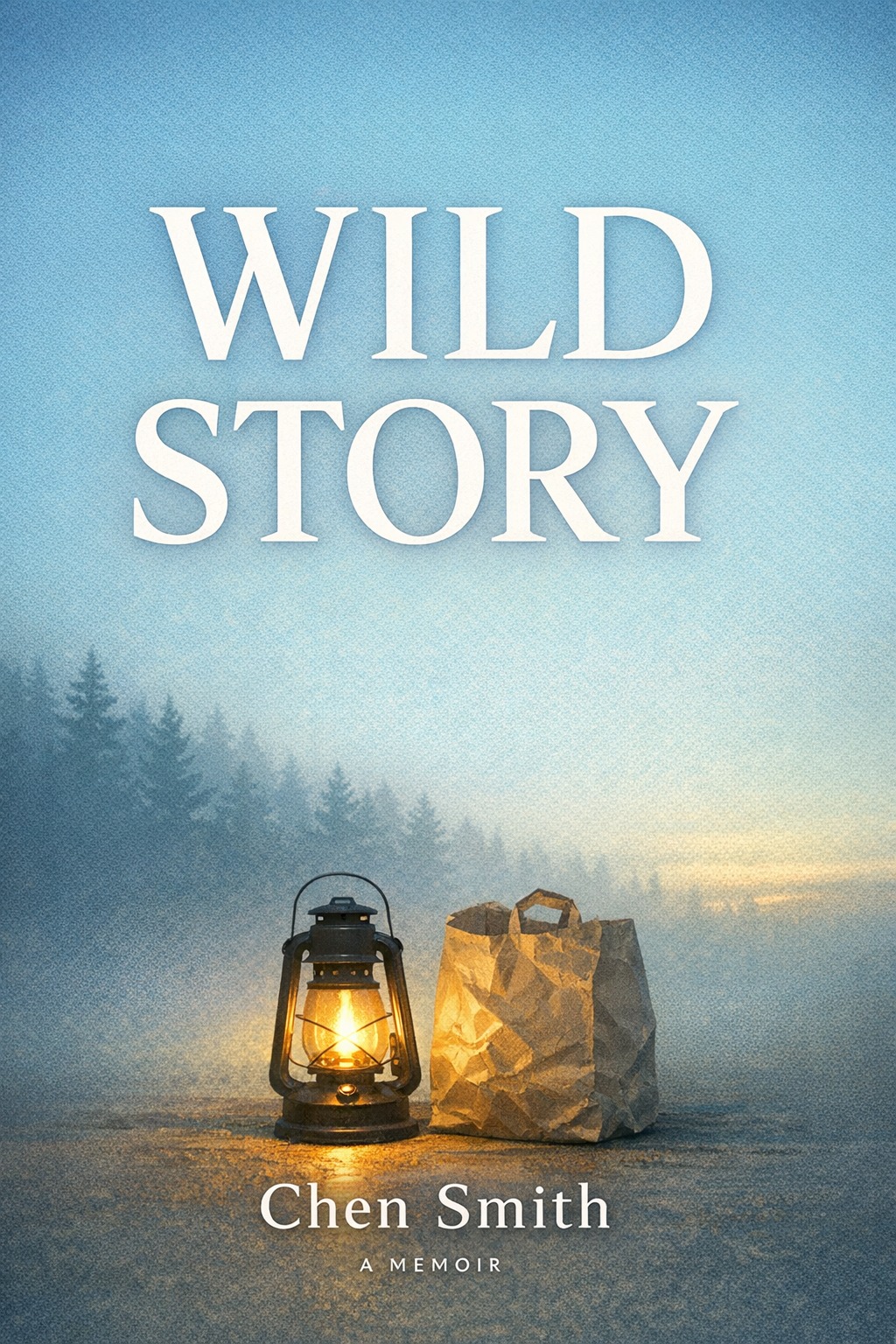
Cover of Wild Story

Wild Story

Memoir · 288 pages · Published 2025-05-13 · Avg 3.8★ (6 reviews)

It began like weather arriving from a clear sky and ended like a door closing in an empty hallway. Our start felt like a dare; our finish, a hush. He reached for me, named a future in the glow of a camp lantern, and then one morning he wrapped that future in a grocery bag and set it next to the recycling. In May 2020, in a narrow Craftsman in Ballard, Seattle, I was tucked in with my small son and a gray cat named Juniper, learning the names of neighborhood crows, frying scallion pancakes in a carbon-steel pan, resetting the backyard radio to the marine forecast. Then, without preamble, my partner of twelve years said he was leaving. Overnight, the gentle archivist who fixed screen doors and labeled old film canisters turned into someone I couldn't place. He took the spare keys, left the sourdough starter and his quiet shadow on the porch.

In Wild Story, Smith walks back through the decade: road trips along I-90, motel ice machines coughing out half-moons, Mandarin voicemails from their mother in Taichung, a map folded to shreds; they search for the moments they misnamed as kindness. As they reckon with family lore—what a Kansan father taught about endurance, what an island-born mother taught about apology—they unlearn the choreography of being agreeable in order to keep the peace. The child once called 'too much' in grade school, the adult praised for 'making it easy,' loosens their throat and speaks. With clarity that refuses spectacle and tenderness sharpened into wit, Smith threads a trail through wreckage toward a renewable tenderness: for a child, for friends on the stoop, for a self with both calluses and hope. Wild Story is an intimate, unsentimental memoir about refusing a supporting role, and about how love remakes its language when the script is ash.

Chen Smith is a memoirist and audio storyteller raised between Overland Park, Kansas, and their grandmother's apartment in New Taipei City. Born in 1986, Smith studied environmental science at the University of Washington and later taught writing at a community college in Tacoma. Before writing full-time, they worked as a bicycle mechanic, a ferry deckhand on Puget Sound, and a producer for a neighborhood radio show. Their essays have appeared in regional journals and on public radio affiliates. Smith lives in Seattle with their young son and a gray cat named Juniper, and leads workshops on narrative craft for community organizations.

Ratings & Reviews

Devon Ma
2026-03-28

A quiet breakup memoir with Seattle rainlight, motel stopovers, and a backyard radio: beautiful in moments, occasionally static. I admired the clarity and the wit, even as the pacing sometimes felt like a long exhale.

Tamsin O'Rourke
2026-03-05

For readers of intimate, unsentimental breakup memoirs that sit close to the stove and the stoop. Expect reflective pacing, clear prose, and scenes of co-parenting in Seattle during early pandemic months. Content notes: separation after a long partnership, a few sharp arguments, financial worry at the edges, no graphic material. Strong fit for book clubs that like craft talk and for adult readers who appreciate cultural hybridity grounded in daily rituals.

Priya Raman
2026-01-22

This is a book about refusing the part of the easy one and learning how to speak at full volume without apology. Smith threads lessons from a Kansan father about staying power with a mother from Taichung whose calls carry apology and care, and turns them into a new vocabulary for love.

I loved the way the memoir keeps gently interrogating agreement, caretaking, and the pull to smooth things over, then answers with attention to friends on the stoop and a child who needs steadiness. Few writers manage to ask how love carries on "when the script turns to ash" and then actually show it, quietly, with wit and clean lines.

Luca Kowalski
2025-12-03

Ballard comes through as a weather system, not a postcard. The backyard radio tuned to the marine forecast, the crows with names, the carbon-steel pan talking heat, all make a dense habitat for loss. I appreciated the atmosphere more than the movement; the meditative drift sometimes blurs chapters together. Still, the May 2020 hush and the motel detours along I-90 keep a low hum of tension.

Chenia Alvarez
2025-08-15

The self on these pages learns to stop shrinking.

As a character study, this is absorbing. The narrator's attention to small domestic acts, frying scallion pancakes, clocking the gray cat's orbit, becomes a way of charting who they are without the partner who once named a future. Conversations are spare but keen, and the child is never a prop. The bewilderment registers as the gentle archivist recedes, while the voice stays generous, wary of spectacle and quick jokes that cut just enough to let in light.

Mara Donnelly
2025-06-01

Smith structures the memoir as a braid of present-tense domestic calm and retrospective road miles; the chapters move like weather fronts that brush past and then circle back.

Scenes echo across the book, from motel ice knocking in its hopper to the kitchen radio's marine forecast, to a grocery bag by the bin where a future used to be. The prose is flinty and purposeful, images land without spectacle, and the restraint makes the small ruptures feel earned. A few passages linger on minutiae a beat too long, but the architecture holds and the closing quiet feels fully prepared.

Generated on 2026-04-01 12:03 UTC