
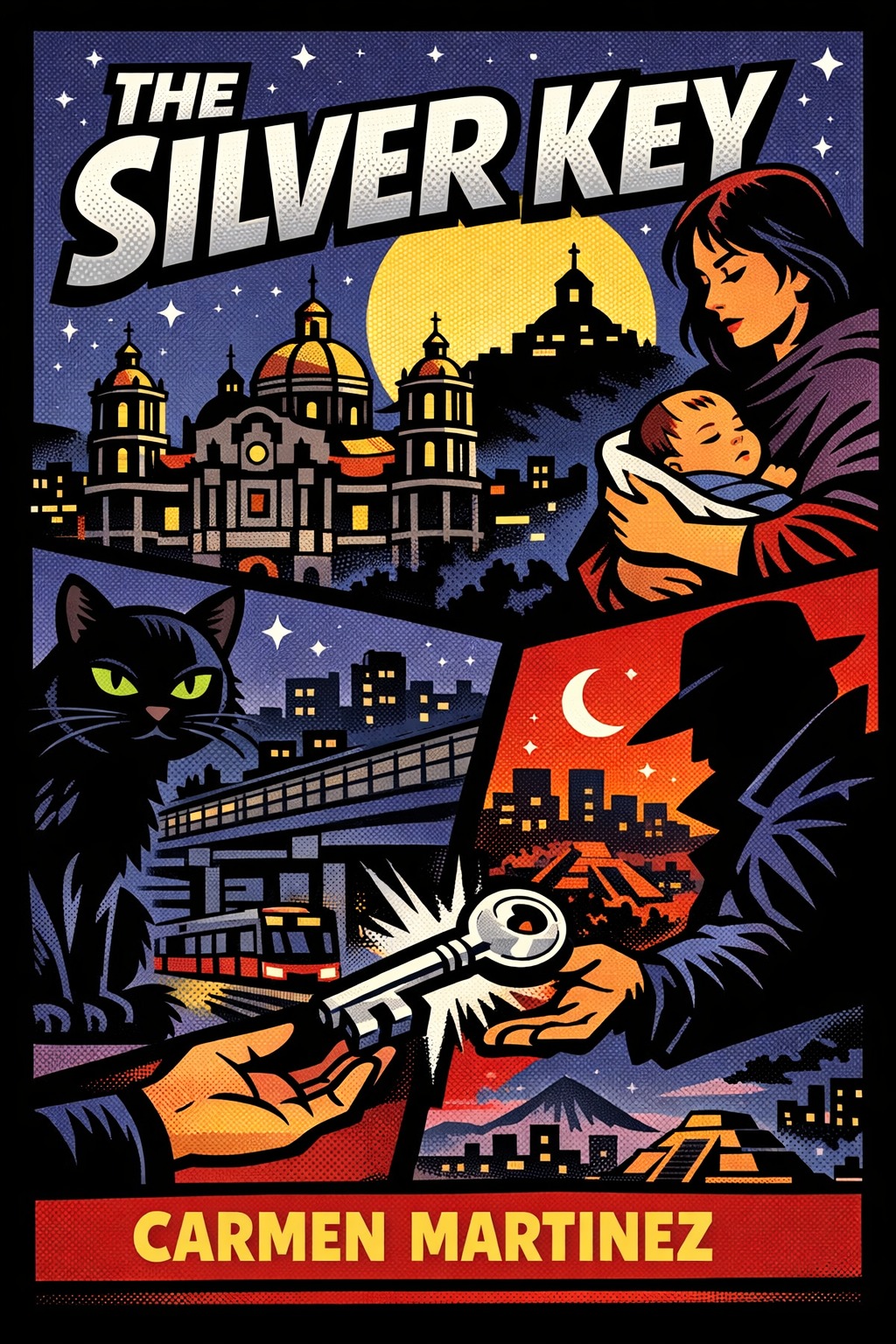
Cover of The Silver Key

The Silver Key

Comics · 112 pages · Published 2025-05-14 · Avg 3.2★ (6 reviews)

A quartet of stand-alone comics traces four quiet miracles across distant cities at night. In each, a silver key passes hands while its keeper appears only briefly there. We meet Rosa Álvarez, mother to a child left at the Basilica of Guadalupe; learn what cats dream beneath Indios Verdes; and uncover the dare behind Molière's Tartuffe. That last tale won the Cascabel Prize for short comics, the first time a wordless sequence was chosen over prose-led contenders by judges. collecting Silver Key #1–4

Martinez, Carmen (b. 1984) is a Mexican American cartoonist and letterer from El Paso, Texas, who grew up crossing the border to Ciudad Juárez. She earned a BFA in illustration from the University of Arizona and completed graduate work in sequential art at SCAD. After assisting at a small Phoenix comics press, she self-published mini-comics that blend folklore with transit maps and nighttime urban studies. Her work has appeared in independent anthologies and gallery shows in Tucson, Austin, and Mexico City. Since 2016 she has lived in Mexico City, where she teaches community workshops and freelances as a colorist and storyboard artist.

Ratings & Reviews

Erin Cho
2026-03-21

This reads like the hushed urban drift of a micropress night-walk minicomic crossed with the tender, deadpan humor of a xeroxed zine about silent comedy. The silver key is a thread and a dare, and the book trusts you to tie the knot.

For readers who savor negative space, patient cutting, and city noise turned down to a heartbeat, this is a keeper. Not for those seeking punchlines or lore dumps; for those who want comics that behave like poetry, it's luminous.

Noah Adebayo
2026-02-13

What I loved most is the way responsibility flickers: not a grand destiny, but a chain of small choices that add up to grace. The key doesn't fix anyone; it invites them to step aside or step up, and that moral hinge is surprisingly moving.

The book keeps circling absence and witness. In one story the "keeper appears only briefly there," and that brevity reframes ownership as caretaking. The motif stays quiet yet firm, helped by patient panel rhythms and a confidence with silence; by the end, the cities feel kinder for having carried a secret between them.

Lucía Palma
2026-01-09

Las cuatro historias respiran ciudad en silencio: la llave plateada cruza manos y barrios como una luciérnaga guiando el ojo, de la Basílica a Indios Verdes, con sombras nítidas, carteles, asfalto húmedo y una calma rara que convierte la noche en escenario.

Gareth Pike
2025-10-05

A nocturnal anthology with a few gleams and a few stumbles.

  • Strong opening image of the key changing hands
  • Issue 2 lingers too long under the overpass
  • Wordless Tartuffe bit has clear beats
  • Final callbacks land softly, not decisively
María Téllez
2025-07-02

The book keeps telling me people matter, but it barely lets them exist. We brush past lives like a tourist on a moving bus, and the silver key is the only thing that gets any screen time.

Rosa Álvarez should break me open. A child at the Basilica is a powder keg of feeling, yet the pages glance off it, flitting to skyline shots when we need breath and voice. I kept waiting to know her beyond a pose.

The cats under Indios Verdes dream, yes, but of what? The sequence hints and hints until the hints feel like hedges. Even the Tartuffe dare, cheeky in premise, keeps its players so distant that the audacity has no sting.

I respect restraint, but this reads like a dossier rather than lives unfolding. Two stars for ambition and a few neat transitions; the rest is a shrugged silhouette.

Dorian Chao
2025-06-18

I came in ready for "quiet miracles" and got quiet pages that feel inert. The silver key is supposed to stitch the cities, yet it keeps vanishing into layouts that confuse more than connect.

Structure first: four stand-alone issues promise echoes, but the handoffs are so faint they read like production accidents. Page-to-page flow jerks, captions undercut pacing, and the page turns rarely land with intention.

The much-praised wordless Tartuffe segment left me cold. A wordless choice should sharpen gesture and timing; instead it reads like a storyboard with missing frames. Learning it won a prize only made the thinness sting more because the other pieces feel even more neglected beside it.

Emotion never surfaces. Negative space swallows character beats, and the key becomes a prop that denies meaning instead of unlocking it. After a while, the hush stops feeling deliberate and starts feeling empty.

I'm frustrated, not challenged. This is the kind of pretty packaging that mistakes obscurity for depth, and it wasted my night.

Generated on 2026-03-26 12:02 UTC