
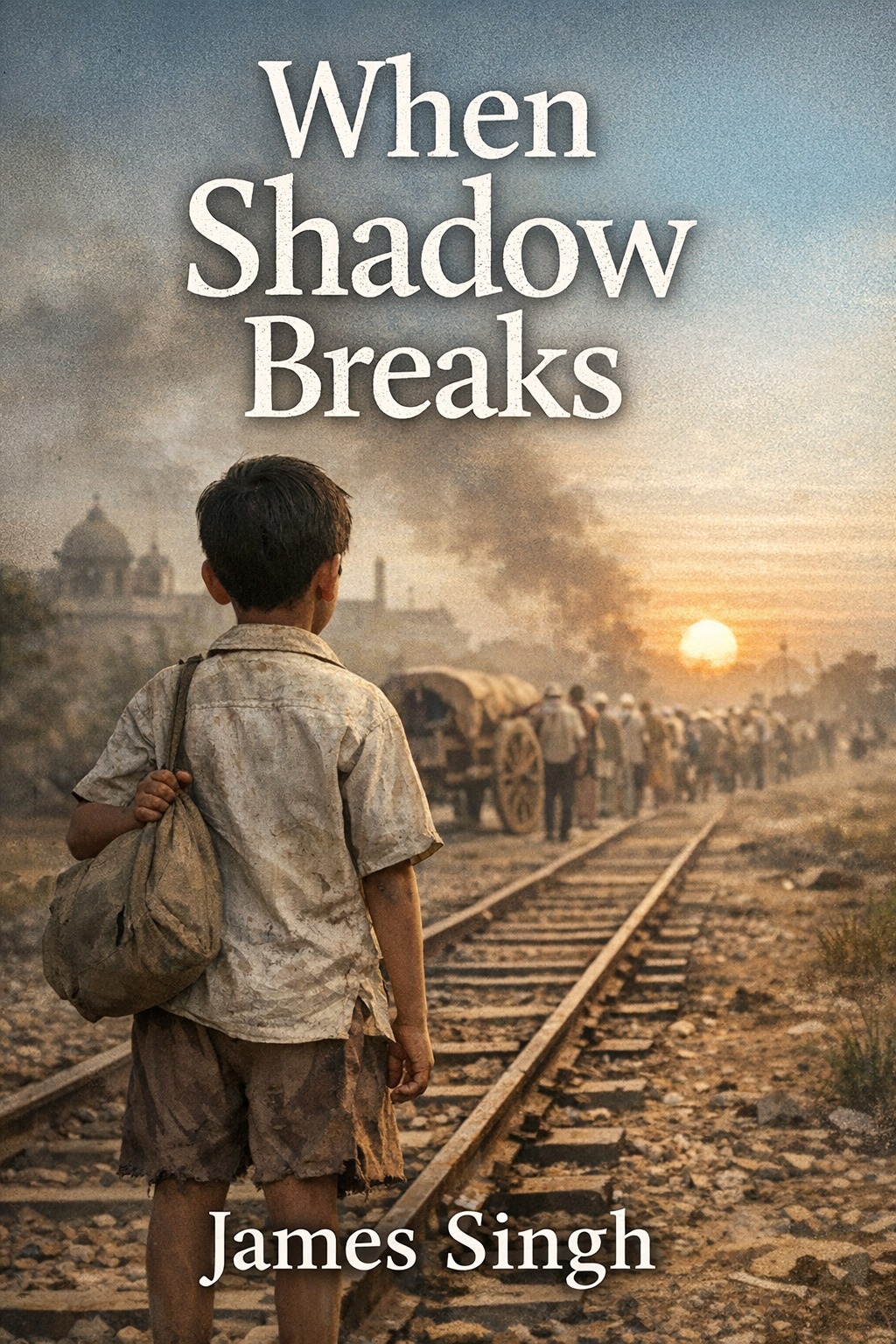
Cover of When Shadow Breaks

When Shadow Breaks

Memoir · 304 pages · Published 2023-10-10 · Avg 2.2★ (6 reviews)

The secret lay dormant for 50 years until James Singh decided to share his past, the story of how his family vanished in the Partition of India and only he remained. From his boyhood in Sheikhupura, Punjab, to the columns of refugees that crawled toward Amritsar, his will to endure was tested again and again.On August 15, 1947, the map split and the trains began running both ways. He wrote, "As I warned you, from here on, this account is going to get rough."James's family was driven from their lane and herded toward the station under a sky the color of smoke. He was swept into a caravan and pressed into guarding the water skins. His father and mother were cut off in the crush outside the gate. As the nights passed, James slept on gravel at Attari and then under torn canvas at Purana Qila in Delhi. Years later, his children learned that one of the "ghost trains" that pulled into Amritsar that week had departed from the very platform where he once waited.

At twenty years old, having nothing left, James left the camp with a stamped ration card and a scrap of a cousin's address, and made his way to the docks at Bombay. He was granted passage to Britain under Commonwealth preference. He arrived at Tilbury Docks on January 17, 1952, with three pounds in his pocket. He did not speak the English of the streets.He became a sought-after sound recordist, a patient listener who learned to turn static into music.

Singh, James (b. 1927) was born in Sheikhupura in undivided Punjab and resettled in Delhi after Partition. In 1952 he sailed to England, where he apprenticed in the BBC's sound department and recorded early South Asian broadcasts for community radio. He immigrated to the United States in 1966, working in New York postproduction studios and later teaching field audio at City College. He raised a family in Jackson Heights, Queens, and in retirement volunteers with oral-history projects archiving migrant voices.

Ratings & Reviews

Graham Patel
2026-02-28

For collections serving students researching South Asian history and migration, this is useful as a first-person account that moves from Sheikhupura to Delhi to Bombay to Britain. The tone is restrained, the chronology clear.

Who it is for: readers who value documentation over drama, book clubs that discuss memory and inheritance, and courses on twentieth-century displacement. Content notes include mass violence, family separation, refugee camps, and off-page death; nothing is graphic, but the sorrow accumulates.

Marta López
2025-09-03

Este libro persigue temas de silencio, duelo y supervivencia. Cuando apunta algo como "trains running both ways", la imagen sugiere una fractura que sigue viva, y el hilo de su trabajo de sonido promete un contrapunto.

Pero la reflexión queda a medio camino: muchas páginas narran la marcha y pocas cuestionan qué hizo el silencio en él, y el cierre resulta conocido.

Daniel Cho
2025-01-14

Read as a journey narrative, this is even and sober.

  • Spare scenes of fleeing and waiting
  • Repetition around camps slows the midsection
  • Final career passages add texture but feel tacked on
  • Clear timeline, low narrative drive
Priya Banerjee
2024-07-20

As a character, James remains careful and distant. His parents fade into outline, his own voice turns dutiful when the camps close, and even the arrival at Tilbury feels reported rather than lived. The later chapters about becoming a sound recordist promise access to his sensibility, but the interiority stays guarded, so the memoir reads like testimony without the pulse of a self.

Farid Hassan
2024-02-05

The landscapes of Partition are here in fragments: a sky the color of smoke, gravel sleep, torn canvas, trains that crawl. It evokes dread, but the sense of place feels provisional, with Sheikhupura and the trek toward Amritsar blurring into a hallway of stations and queues.

The world-building of loss weighs more than it clarifies.

Nigel Morton
2023-11-12

Singh frames his life in clean, chronological shards, but the arrangement keeps slipping back on itself; scenes from Attari and Purana Qila recur until the momentum flattens. The warning, "As I warned you, from here on, this account is going to get rough," arrives early, yet the prose often steps away from the roughest edges, summarizing where it could stay with a moment.

The sound motifs are the most interesting thread, static turning into music, footsteps into measure, yet the book never lets them develop into a structure that holds the whole.

Generated on 2026-03-24 12:02 UTC