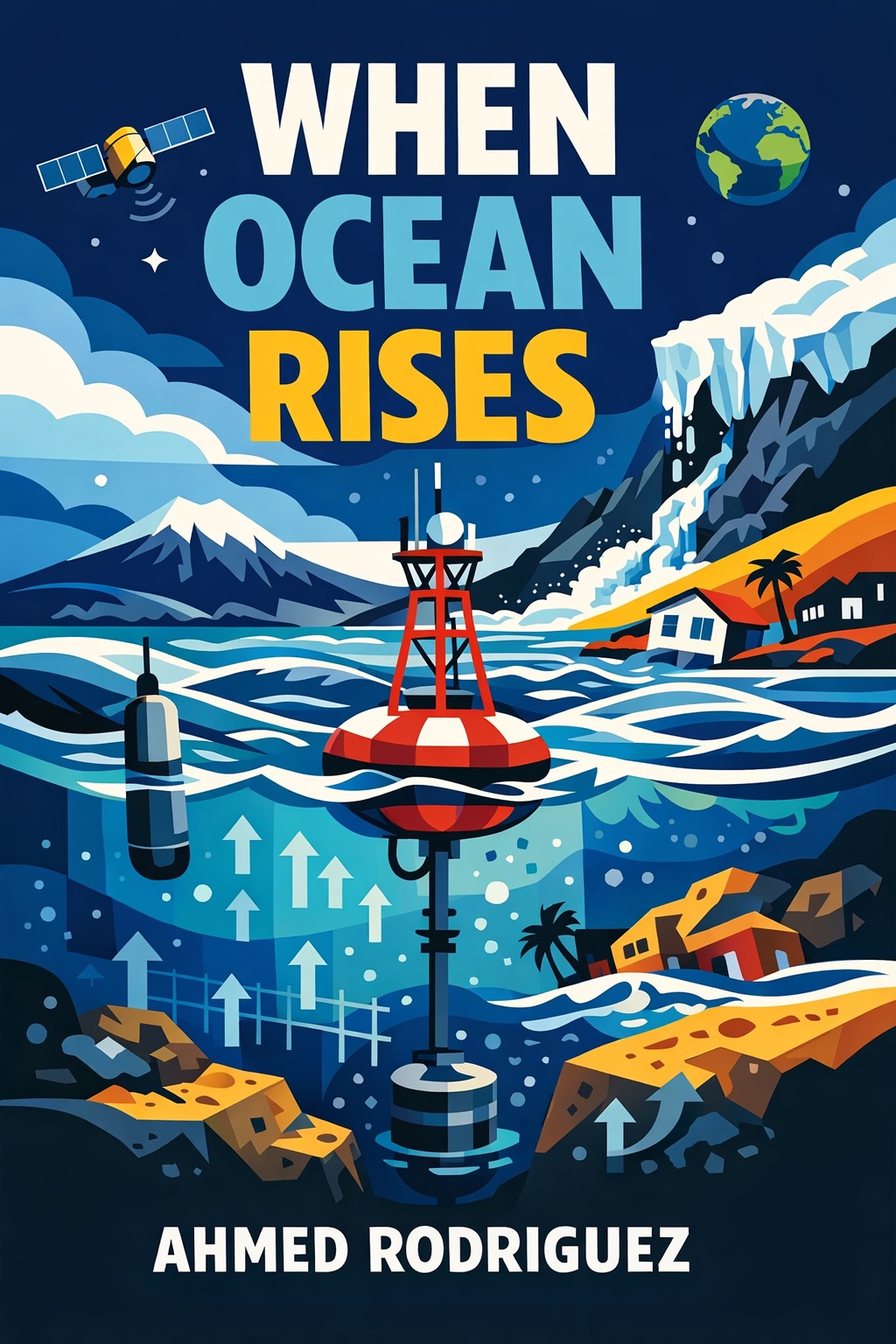
Cover of When Ocean Rises

When Ocean Rises

Science · 304 pages · Published 2024-11-05 · Avg 3.0★ (6 reviews)

Using tide-gauge archives from Brest to Suva, GRACE and Sentinel satellites, and Argo float measurements, When Ocean Rises disentangles the physics behind sea-level change. Rodriguez shows why thermal expansion, ice-sheet melt, and vertical land motion produce uneven coastlines, and how feedbacks like ocean stratification and changing winds shift regional risk. Clear diagrams and compact equations illuminate terms such as steric height, glacial isostatic adjustment, and compound flooding.

Case studies follow seawalls in South Tarawa, pumps beneath Miami Beach, and managed retreat near Napier, paired with interviews aboard research vessel Sarmiento de Gamboa. Field notes from Greenland meltwater plumes, GPS stations in the Sundarbans, and reef cores in the Coral Sea reveal how scientists measure change in millimeters per year. With an eye on uncertainty, Rodriguez surveys early-warning systems, AI downscaling for neighborhood flood maps, and practical thresholds that communities from Rotterdam to Lagos use to plan the next century.

Ahmed Rodriguez is an oceanographer and climate data scientist whose work focuses on regional sea-level change and coastal risk. Born in 1983 in El Paso to Cuban and Pakistani parents, he studied civil engineering at the University of Texas at Austin and earned a Ph.D. in physical oceanography from Scripps Institution of Oceanography. He has held research posts at NOAA and the University of Lisbon, contributed to the IPCC Sixth Assessment Report on sea level, and published in Nature Climate Change and Geophysical Research Letters. Outside the lab, he mentors first-generation students and crews on volunteer hydrographic surveys along the Gulf Coast.

Ratings & Reviews

Tariq Ben Salem
2026-03-18

The shipboard and Sundarbans interviews read so clipped that the voices blur together, dulling what should be the book's most human pulse.

Sofía Aranda
2026-03-01

Me recordó a Orrin Pilkey por la franqueza con las costas y a Heidi Cullen por la claridad al explicar los datos. Desde los mareógrafos de Brest y Suva hasta GRACE, Sentinel y las boyas Argo, el libro combina técnica y periodismo sin perder el hilo de riesgo regional.

Para lectores que quieran pasar de titulares a decisiones locales, funciona muy bien: los casos de South Tarawa, Miami Beach y la retirada planificada en Napier muestran cómo convertir mapas y umbrales en políticas de barrio con ayuda de IA. No es ligero, pero es honesto y útil.

Hugh McNulty
2025-12-11

The strongest motif here is uncertainty treated as a working tool rather than an apology. Rodriguez keeps returning to millimeters per year, to confidence bounds, to the ethics of acting before certainty arrives.

I appreciated the attention to community rules of thumb and the way "practical thresholds" become social contracts. Still, the balance between models and human context sometimes wobbles, leaving the interviews to carry themes they only partially bear.

Priya Laghari
2025-07-29

Rodriguez maps the sea like a layered machine: tides and steric height on one gear, ice-sheet melt and glacial isostatic adjustment on another.

The world feels specific and consequential, from Brest to Suva, as stratification and shifting winds rearrange regional risk. Sensor networks become part of the setting—Argo floats roaming, GRACE weighing water, Sentinel tracing surfaces—while seawalls in South Tarawa, pumps in Miami Beach, and retreat near Napier ground the abstractions in lived shoreline choices.

Marin O'Keefe
2025-02-07

I came to this book wanting the ocean to speak, but I kept tripping over footnotes and figure callouts. By the third chapter I was exasperated, circling terms that should have been integrated into the story instead of stacked like roadblocks.

The pacing sags under a churn of datasets. GRACE, Sentinel, Argo, tide gauges, GPS arrays—yes, they matter, but endless acronym parades smother the urgency the interviews try to spark.

Equations meant to be "compact" start to feel compulsory. Steric height and glacial isostatic adjustment are defined, then redefined, and the flow stalls just when the South Tarawa or Miami sections might breathe.

The stakes are real, yet the structure leans toward lecture. Chapters feel stitched rather than braided, so momentum keeps evaporating exactly when risk and response should lock together.

I needed more time with the people behind the gauges and the pumps, not another appendix chasing units and error bars. Frustrating, because the material matters and the craft keeps getting in its own way.

Galen Cho
2024-11-18

A clear yet uneven primer on sea-level physics.

  • Clean diagrams and compact equations
  • Jargon explained with brief definitions
  • Case studies feel clipped
  • Narrative momentum stalls in method sections
Generated on 2026-03-20 12:04 UTC