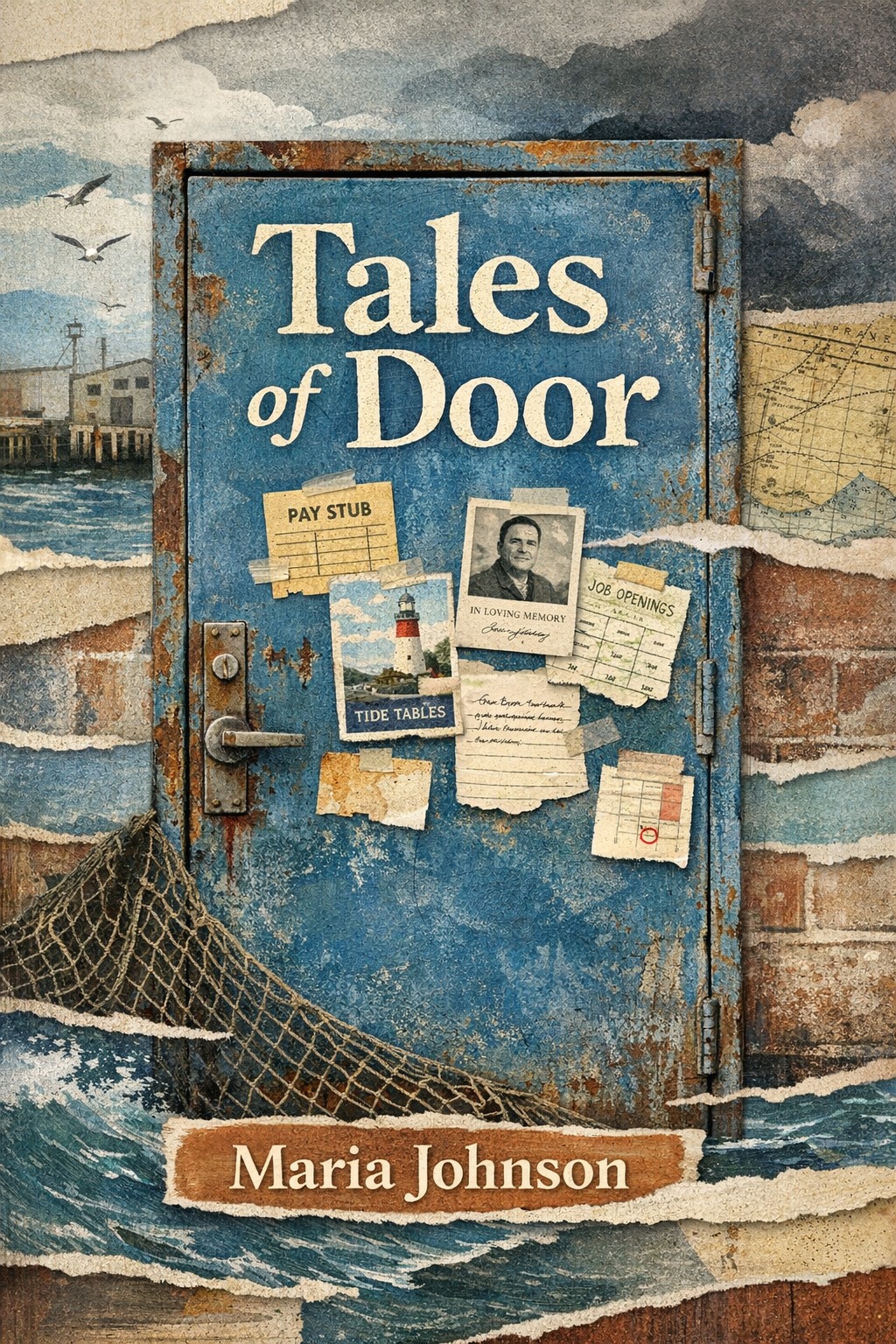
Cover of Tales of Door

Tales of Door

Nonfiction · 288 pages · Published 2025-08-12 · Avg 3.3★ (6 reviews)

On the back side of Pier 7 off Allens Avenue in Providence, behind a decommissioned fish-processing plant, there is a seaworn steel service door painted harbor blue. For years, dockhands and lineworkers have taped pay stubs, memorial cards, tide tables, and job leads to that door. On storm mornings someone chalks a prayer; on clear nights a joke. When the plant shutters and the last Hyster forklift is craned onto a flatbed, the door becomes a stubborn commons. Johnson, Maria returns weekly with a field notebook, a scratched Olympus recorder, and a thermos of Autocrat coffee milk, following the names and numbers left there into kitchens, wheelhouses, union halls, and triple-deckers from India Point to Point Judith.

Tales of Door gathers twelve braided narratives that begin at the hinge and sweep out across Narragansett Bay: Letty Soares, a scallop diver whose father vanished off the Hen and Chickens; Marco De León, a deckhand living aboard the tug Emily J who keeps a Polaroid taped to the bottom corner of the blue paint; Nora Pimental, running the dawn shift at Seaplane Diner with a clamming rake leaning by the back door; the quiet custodian at Hope High who writes driftwood poems in Portuguese; a lighthouse caretaker cataloging ghost lights by NOAA Chart 13223. Their stories touch wage theft and a 1998 wildcat strike, the Fox Point Hurricane Barrier, a winter of red tide closures, and the sorrow of finding a single boot wedged in eelgrass off Conimicut Light while a foghorn counts the seconds.

Told with the clarity of a reporter and an ear for working-water folklore, this book dwells on thresholds: sea to shore, night to morning, silence to speech. As the layers of paper thicken and peel, a community stumbles, forgives, and persists. The door does not rescue anyone, but it asks us to pause, to read each other, and to step through. In rust, salt, and ink, Tales of Door is a reminder that ordinary words—scrawled with a felt-tip on a blue steel panel—can change the way we carry one another.

Johnson, Maria is a coastal New England–based writer and former crime reporter. Born in Corpus Christi, Texas, in 1986, she studied anthropology and journalism at the University of Texas at Austin before moving to Providence, Rhode Island, where she covered small-town courts and waterfront labor for a regional paper. Her short fiction has appeared in indie magazines and anthologies focused on dark folklore and maritime myth. When not writing, she volunteers with a lighthouse preservation group and hikes tidal flats with a field notebook. She lives with her partner and a retired harbor cat in a drafty apartment within earshot of foghorns.

Ratings & Reviews

Fatima Pires
2026-03-15

Indicado para leitores de narrativas de trabalho e história oral do litoral, com foco em Providence e na Baía de Narragansett. Ótimo para turmas do ensino médio avançado e clubes de leitura comunitários interessados em jornalismo literário. Conteúdos a considerar para educadores e mediadores de leitura incluem luto no mar, roubo de salário, greve e descrições de achados no litoral. A escrita é clara e respeitosa, e o motivo da porta azul ajuda a conectar as doze histórias sem exigir conhecimento prévio.

Caleb Wren
2026-03-01

I came here for testimony that bites, and too often I found ornament. The book admires its hinge and paint when it should cleave closer to the bruises.

Yes, the dock prayers, pay stubs, tide tables, and jokes are real; the people are real; but the frame leans in so hard on the icon of that blue panel that the labor becomes backdrop. It grated.

The themes want to braid thresholds of sea and shore, silence and speech, but the staging turns into a shrine. The repeated insistence that "the door saves no one" reads like a hedge, because the prose keeps polishing it until it glows.

I felt the sentimental glaze whenever the foghorn counts seconds or a single boot sits in eelgrass, and by the third return to the hinge I was frustrated. Hard weeks, wage theft, a strike, closures in a red tide winter deserve edges, not halo light.

There are moments of honesty, but they are boxed by motif and reverence, and that choice drained urgency. Two stars, because the work matters, yet the treatment left me cold.

Derek Chu
2026-02-10
  • Strong sense of place
  • A few sections linger too long on scene-setting
  • Memorable voices from diner to tugboat
  • Momentum dips around the red tide winter
Anita Salgado
2026-01-05

Letty Soares, Marco De León, Nora Pimental, the custodian writing in Portuguese, the lighthouse caretaker logging ghost lights by NOAA Chart 13223, each arrives with a distinct cadence. Johnson lets quiets hang after a line of dock talk, and the pauses feel earned; even a Polaroid taped low on the door carries a voice.

Gordon Ellison
2025-11-18

Maria Johnson writes with a reporter's steadiness and a folklorist's ear, and the recurring door keeps the threads aligned even as the shoreline shifts. The structure is braided reportage: twelve strands that begin with taped scraps and widen into kitchens, wheelhouses, and union halls. At times the jump cuts can feel airy, and the timelines blur, but the sentences are clean, the details disciplined, and the blue paint holds.

Lena Morales
2025-09-07

A salt-and-iron chorus about a blue steel door that becomes a tide-washed bulletin board, these twelve pieces carry Providence's working water from Allens Avenue to Conimicut Light with tenderness and grit.

Generated on 2026-03-18 12:03 UTC