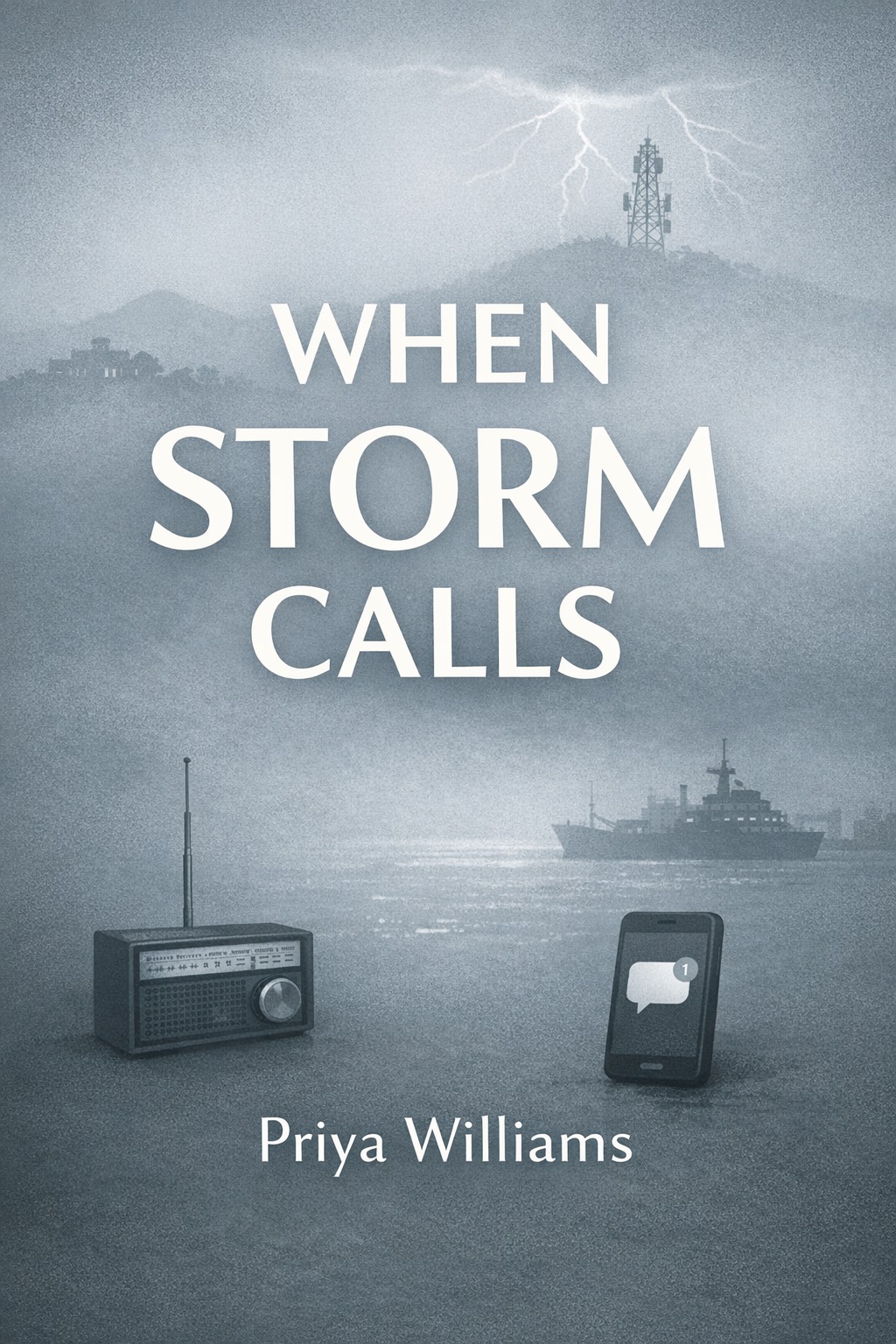
When Storm Calls traces the social life of alarms across the subcontinent, asking a deceptively simple question: who is allowed to warn? Moving from hill stations to harbors, and from crackling transistor radios to the bright ping of WhatsApp, Williams, Priya follows the objects, phrases, and small gestures that braid communities together in the hours before and after a deluge. Drawing on oral histories, vernacular photographs, and the overlooked paperwork of disaster—ration tokens, relief coupons, municipal logbooks—this is a history of monsoon modernity told from bazaar lanes, bus stands, and living rooms.
In Shimla's Lower Bazaar, a retired porter remembers winding the hand-cranked siren at the fire station while his daughter listened for the three-long-one-short code that meant landslide. In Nainital's Tallital police lines, a brass barometer—imported by a grocer in 1936, family sacred even when it stopped working—becomes a household oracle every June. Mussoorie's boarding schools keep neatly typed evacuation charts, their edges soft with thumbprints; in Mandi, a network of canteen-keepers uses Nokia 1100s to ripple word of rising waters through tehsils long before a district circular arrives. A chapter on the Snowdon Hospital in Shimla tracks how nurses trained to read cloud color as closely as patient pallor; another sits in the dark of a generator room while All India Radio's bulletin, clipped and precise, hums between cups of overboiled tea.
The coast offers a different archive of noise and notice. At Paradip and Puri, fishermen describe the old cone-and-drum cyclone signals—wooden shapes hoisted up a mast—now overshadowed by IMD push alerts and the confident weather graphics of private apps. Relief camps outside Cuttack remember the 1999 Odisha Super Cyclone not only as wind and salt but as queues, numbered tokens, and rain-wet ink. A shopkeeper in Kendrapara keeps a laminated list of boat phone numbers wrapped in a blue tarpaulin, while a schoolteacher in Bhadrak hoards the batteries that kept a tiny Philips transistor alive through Phailin and Fani. The book lingers on objects that traveled far and fast—orange NDRF boats, yellow hard hats, plastic buckets stamped with corporate logos—asking what they promised and what they delivered.
Threaded throughout is a history of suspicion: the auntie branded a "rumor-monger" for forwarding an early voice note; the municipal chowkidar disciplined for "creating panic" when his whistle sounded before an official memo; migrant workers told to go back uphill because they were, in a ward officer's phrase, "bringing the flood." Williams reads court cases under IPC 505, district circulars printed at midnight, and the casual judgments made at tea stalls, showing how gender, caste, and class decide which calls count as care and which as trouble. The book is often funny—a field guide to storm words, a glossary of homemade siren imitations—but its wit serves a serious end: to notice the people who carry knowledge between institutions and neighborhoods.
Across chapters, the Himalaya and the littoral speak to each other through kinship and telephony. A grandmother in Tehri narrates the day the Bhagirathi turned brown and thick; her grandson in Birmingham remembers the 2005 tornado that flipped roofs in Sparkbrook, calling home to ask if tornados and cloudbursts listen to the same gods. Between Delhi and the English Midlands, mobile phones become talismans and bridges, their call logs a private climate archive. The book follows these networks, charting how warnings, like weather, cross languages and borders with stubborn ingenuity.
When Storm Calls is a microhistory of alarms and a cultural history of attention. It asks readers to rethink "preparedness" not as containment but as hospitality—an ethic of opening doors before certainty arrives. With maps drawn from municipal files, family albums annotated in three scripts, and interviews recorded over the hiss of rain on tin roofs, Williams invites us into the ordinary rooms where people decide whether to believe a voice, share a rumor, or step onto a wet road to knock on a neighbor's door.