
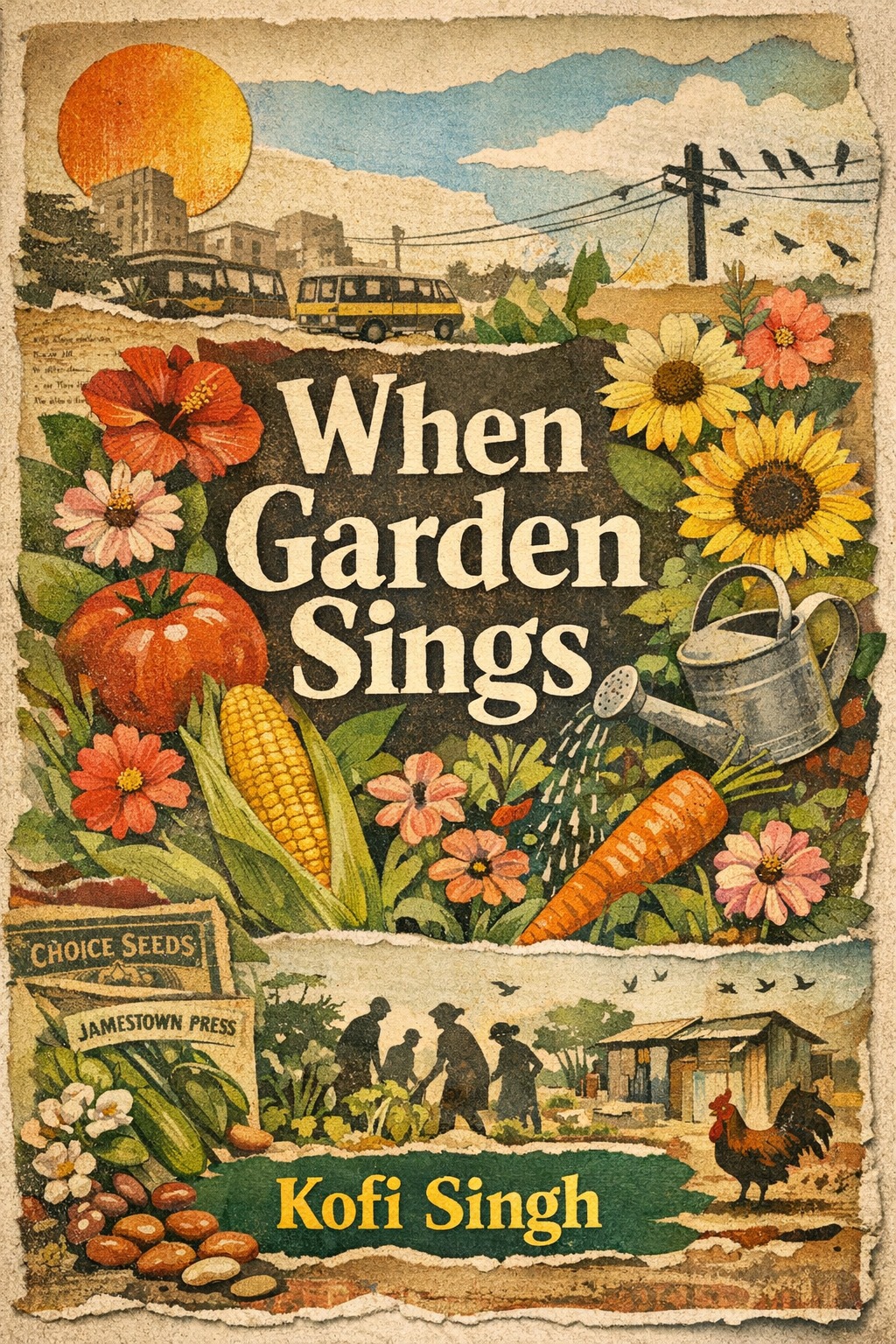
Cover of When Garden Sings

When Garden Sings

Fiction · 224 pages · Published 2022-05-17 · Avg 2.2★ (5 reviews)

Archivist's note: An alternate cover edition for this title exists through the Makola imprint, featuring a seed-catalogue jacket from the Jamestown press.

A neglected lot behind the tro-tro depot on Kojo Thompson Road is seized by its overworked, overlooked neighbors—Auntie Naana Owusu, sign-painter Kojo Lamptey, Pastor Lartey, and a dented blue watering can they call Ajua. With blazing zeal and painted slogans—"Sunlight For All," "Water Without Walls"—they set out to raise a patchwork Eden of tomatoes, yams, and mercy. Thus begins one of the sharpest urban fables in recent memory—a glass-bright parable for adults that traces the drift from commons reclaimed to a committee's rule just as choking. When When Garden Sings first appeared, many read Accra's City Hall as its mark. Today it is piercingly clear that anywhere a fence goes up in the name of order, under any banner, the clean cut and sly music of Kofi Singh's tale still hum, wickedly alive.

Born in 1984 in Sekondi-Takoradi, Kofi Singh is a Ghanaian writer and community gardener. The son of a Fante seamstress and a Punjabi mechanic, he studied landscape design at Kwame Nkrumah University of Science and Technology and earned an MA in creative writing from the University of Cape Town. He has coordinated seed libraries in Accra's Jamestown, volunteered with neighborhood compost programs, and taught night classes in urban ecology. His fiction has appeared in West African small magazines and diaspora journals, and his novella Palm-Wine Harmattan received the Abibiman New Voices Award in 2019. He lives between Accra and Kumasi, where he tends a narrow plot of moringa and mint.

Ratings & Reviews

Marjorie Boateng
2026-02-14

Singh's moral arc is sharp but narrow, asking who gets to define "a commons turned committee" and what mercy looks like once minutes and bylaws arrive. The slogans promise openness, yet the fable folds inward into lesson rather than life. Smart, sure, but short on surprise.

Kwaku Bentil
2025-07-08

Accra hums in the background: tro-tros coughing, sun bouncing off corrugated tin, hand-painted slogans flaking as the seasons turn. I liked how the dented blue can accrues stories and how the fence line creeps inch by inch. Still, the city is mostly observed from curb height, so the stakes stay abstract.

Ruthie Adade
2024-03-19

These neighbors read like posters rather than people; a pity, because the dents in Ajua hint at the complicated lives the book keeps at arm's length.

Lionel D. Mensah
2023-01-12

Singh's sentences ping with neat rhythms, but the arrangement feels clipped and schematic, as if every scene were a signboard. Chapters read like linked notices rather than lived moments; the book wants to be melody but becomes metronome. I admired the recurring slogans and paint motifs, yet the structure squeezes out momentum.

Ama K. Ofori
2022-06-05

A lean parable about a seized lot that drifts into fussy committee squabbles. The pacing stalls in the middle, and the ending feels preordained rather than earned.

Generated on 2026-03-07 12:03 UTC