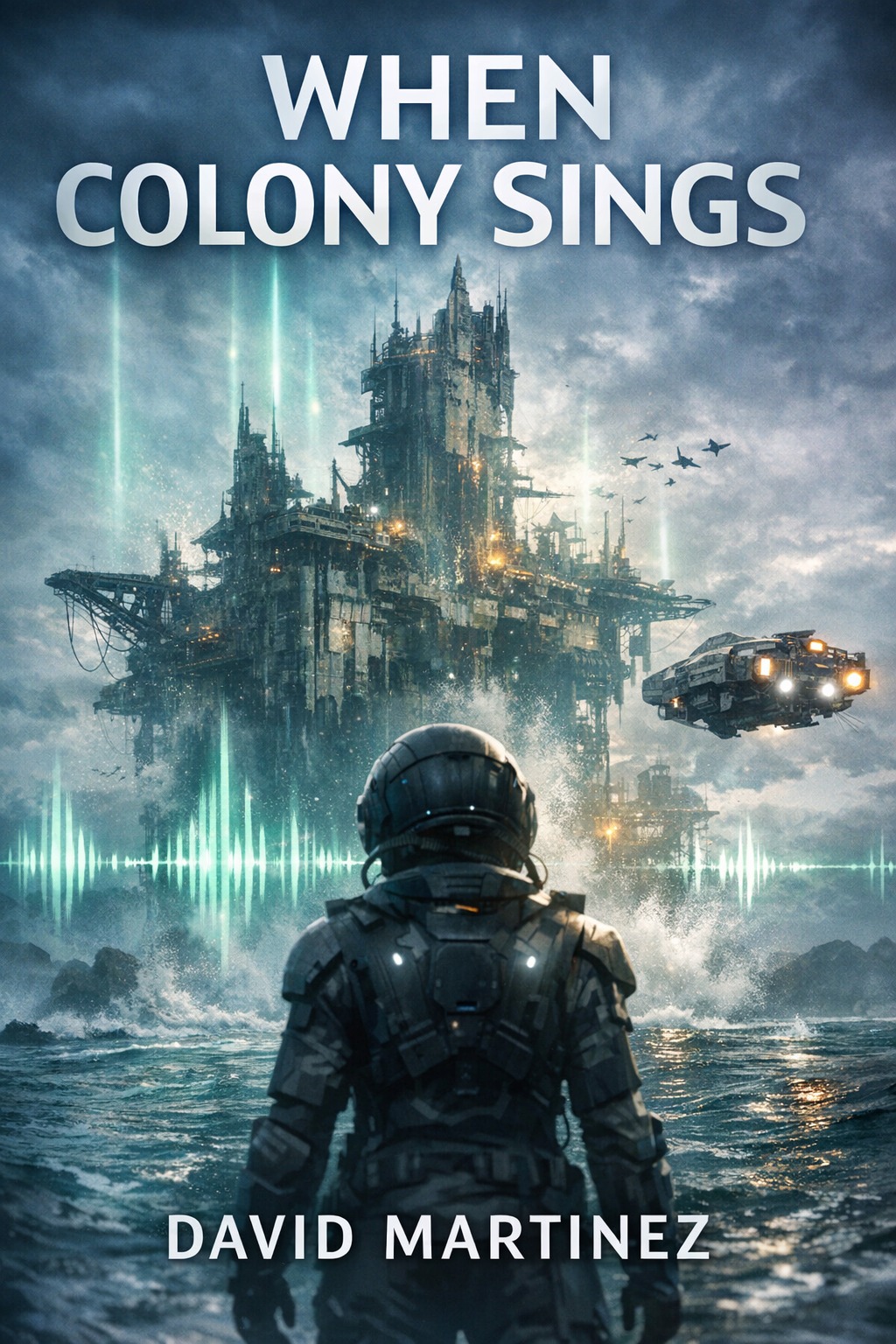
Cover of When Colony Sings

When Colony Sings

Science Fiction · 392 pages · Published 2024-09-24 · Avg 3.5★ (6 reviews)

You can't trust your ears—and you sure as hell can't trust the chorus.

The salvage corvette URV Sibilant is dispatched to Kora-9, a reef-world whose abandoned terraforming rigs have begun to broadcast a pattern—an emergent "song"—strong enough to stall satellites and crack hull plating. Captain Imani Veer's orders from the Outer Reserves are tangled and cruel: extract any surviving colonists from the ghost-settlement at Verdigris Port, copy the pattern's core "songseed," and then erase every trace before rival powers can hear it. The first task is a long shot. The second could doom anyone who tries it.

The route runs straight through the Hush Corridor, territory of the Anchorate of Jin Xiu—neutral, wealthy, and vindictive. Their Silver Lantern escorts shadow Sibilant from jump to jump, enforcing treaty law that forbids weapons fire, jamming, even loud emissions. One stray harmonic ping could be construed as an attack, and the Anchorate's embargo cannons have toppled empires. Veer's crew—parolees, debt-hardened techs, and choir-dropouts signed under Indenture 7-B—learn to move like whispers.

But the Sibilant was fitted in a rush with a temperamental cantor drive. Each "drift" through subharmonic folds peels at perception: gauges hum in human voices, bulkheads throb like a heartbeat, and crew in anechoic hoods mumble melodies they swear they never learned. Lenka Sayegh hears her dead sister coming from a drain. Navigator Tannen Zed charts a course by tinnitus. Cook-bosun "Chalk" bites his tongue to check if the blood is his.

Kora-9's cathedral reefs pulse on the midnight tide. Verdigris's survivors wear mouthguards to keep words from escaping, yet the air itself vibrates with intent. The song is not merely information—it is an organism, a lattice that edits those who listen. When your shadow hums back and your bunkmate mouths someone else's lullaby, who do you believe? When Colony Sings plunges into harmonic dread, where you can't trust your own senses—and the only way home might be to join the choir.

Martinez, David is an American writer and audio engineer born in 1981 in Las Cruces, New Mexico. A former U.S. Navy sonar technician, he spent six years aboard destroyers mapping underwater soundscapes before earning a B.S. in electrical engineering and a graduate certificate in acoustics from the University of Washington. He has worked as a field recordist for documentary crews in the Sonoran Desert, a maintenance lead in a Seattle maker space, and a consultant designing sound masking systems for hospitals. His short fiction has appeared in regional anthologies and small-press magazines, and he has taught community workshops on speculative worldbuilding and the physics of sound. He lives in Tacoma with his partner and a rotating collection of salvaged synthesizers.

Ratings & Reviews

Rowan McKibben
2026-02-20

The novel announces a thesis early, "you can't trust your ears", and then keeps circling it without deepening the idea. Information as parasite, consent as signal hygiene, identity as harmony or dissonance are all sketched, but the argument stays abstract.

Because the plot constrains speech and action, the motifs recur until they blur, and the characters thin out under the chorus. I admired the ambition, yet the droning repetition left me outside the song.

Soraya Patel
2025-12-14

For readers who want mood-first science fiction with clear ground rules, this mostly lands. If you need quips and big battles, temper expectations.

  • Haunting premise built from silence and treaty constraints
  • Methodical pace that sometimes loops one image too many
  • Sound-horror vibe that is fresh for space opera
  • Underplayed relationships outside the core trio
Gideon Armitage
2025-08-22

The setting feels singular and lived in. Treaty law forbids loud emissions, Silver Lantern escorts shadow every jump, and the Anchorate's embargo cannons have toppled empires.

Kora-9's cathedral reefs pulse with intent and the pattern behaves like life: a lattice that edits any listener.

Lucía Prieto
2025-03-09

Lo que más me atrapó fueron las voces internas del equipo. Lenka Sayegh escucha a su hermana en un desagüe, Tannen Zed navega con zumbidos y el cocinero apodado Chalk se muerde la lengua para confirmar que sigue siendo él, y esa terquedad íntima sostiene la misión cuando el mundo intenta reescribirlos.

Las dinámicas son calladas pero intensas, con diálogos cortos, cargados de intención por las limitaciones del Hush Corridor. Me habría gustado un poco más de calor entre ellos, pero el retrato de trabajadores bajo contrato que se mueven como susurros me pareció honesto.

Ethan Alvarado
2024-12-18

The prose leans into acoustics, with gauges that murmur and bulkheads that throb, and the chaptering snaps from hush to surge in satisfying syncopation. Sometimes the sonic metaphors stack so high that scene geography gets fuzzy.

The middle stretches in the Corridor are intentionally constricted by treaty law, which is a bold structural choice that trades momentum for texture. The landing is controlled and smart, even if the route there wavers.

Mara Chen
2024-10-05

When Colony Sings rides a tense silence as the Sibilant tiptoes through the Hush Corridor while the cantor drive whispers mutiny and the three-part mission tightens like a noose.

Generated on 2026-03-01 12:03 UTC