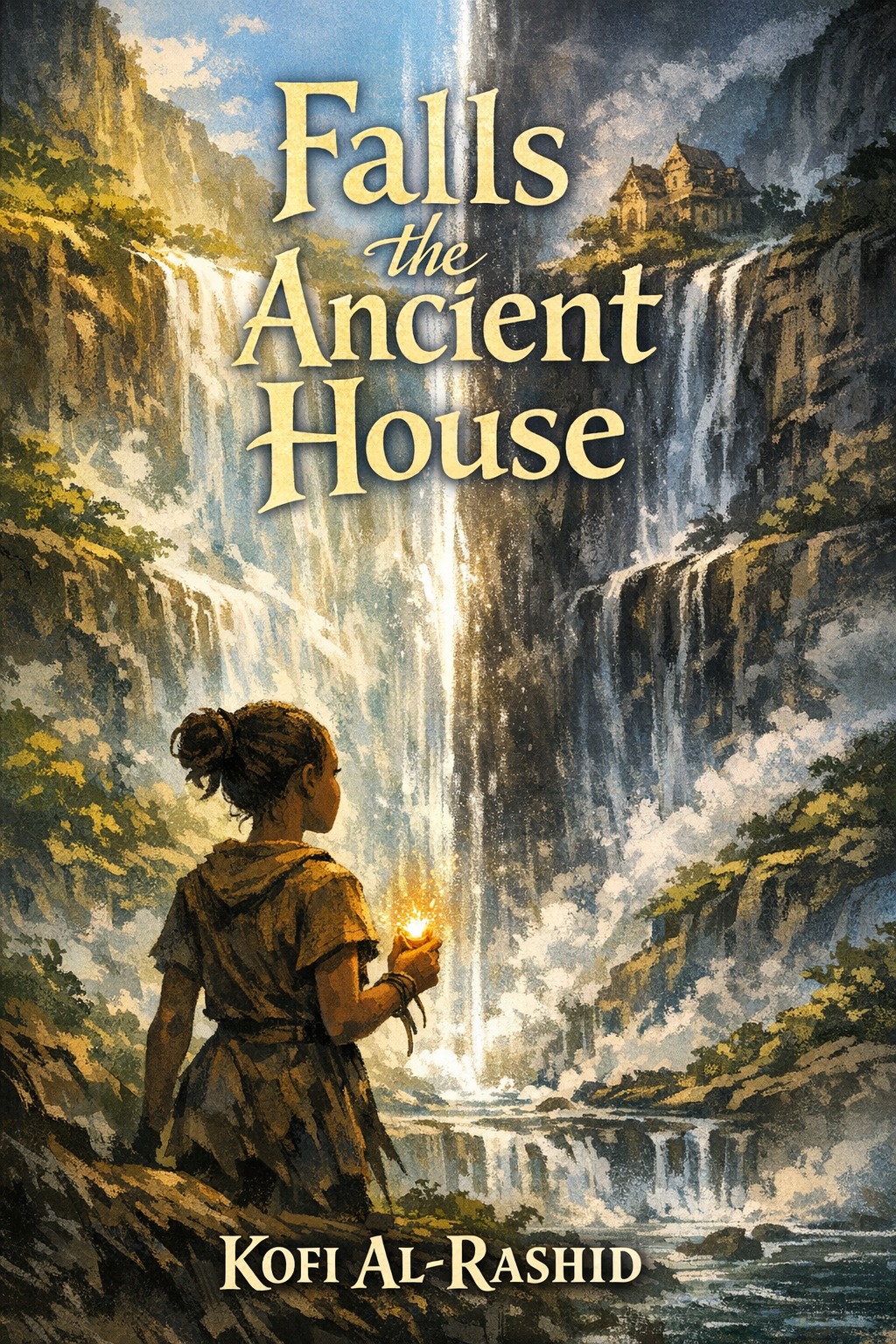
Cover of Falls the Ancient House

Falls the Ancient House

Young Adult · 344 pages · Published 2023-09-19 · Avg 2.7★ (6 reviews)

Light always drags a twin behind it, and where that twin touches the world, the air goes thin. In the spray-hung gorge of Kulu Falls, where water stitches cliff to river, that touch has a name: the seam. Amara Quaye has spent sixteen years in the Sekondi District Home, clutching the one thing her mother left behind—a palm-sized daybook filled with lullabies that turn, page by page, into warnings and maps drawn in charcoal and salt. The margins mutter of adinkra signs and a door below the roar. So when a letter arrives bearing an ebony seal stamped Gye Nyame and a neat hand that calls her "kin," Amara boards a rusted bus north, to the House of Adako above the Ankobra's bend—a manse the fishermen call the Ancient House.

No one at Adako expects her. Auntie Sefah, the housekeeper, stares as if Amara has stepped out of a drowned photograph; her cousin Yaw Adako, all sharp cheekbones and sharper rules, tells her the invitation was a mistake. And yet the halls hum like a beehive under rain, and in the corners Amara glimpses paper-thin figures slick with riverlight, bending at the waist as if trying to listen. She will not leave the first place that smells like kenkey and smoke and belonging. Drawn by the drawings in her mother's daybook, she follows a thread of shell beads through the Fadeless Gallery, down to a ruined arch veined with obsidian. At blue hour, when the mist turns white as bone, she slides between stones and steps into a world that is Adako—but sidelong, saturated: the floors furred with moss, the portraits blinking, the specters heavy enough to leave wet footprints, and a figure in a coat of fish-scale lacquer sitting the length of the long table. He smiles and calls himself the Flood-Keeper.

In that other Adako, Amara learns what has been eating the Adako line from the inside out, and how a boy with her father's sea-glass eyes walked across in a year of famine and never properly came back. The seam needs tending, the house needs a namekeeper, and the river is hungry for every name it can take. Amara has wanted a home her whole life, a tether that does not fray, but the cost of belonging is counted in salt and silence. Will she take her place at the lintel, an Adako meant to hold the world fast against the undercurrent, or will she fold her hand into the Flood-Keeper's and let the Ancient House fall the way water falls—surrendered, unbroken, forever?

Kofi Al-Rashid was born in 1989 in Kumasi to a Lebanese father and a Ghanaian mother. He studied architecture at Kwame Nkrumah University of Science and Technology and conservation at the American University of Beirut, then worked as a documentation officer for a heritage nonprofit in Accra. His short fiction has appeared in Omenana, Jalada Africa, and Transition. He writes young adult fiction that folds West African folklore, urban memory, and quiet hauntings into contemporary settings. A former resident at the Ebedi International Writers Residency, he also leads community workshops on oral history in Sekondi–Takoradi. He lives between Accra and Abidjan.

Ratings & Reviews

Tasha Greenwood
2026-01-11

Librarian take, and I am frustrated on behalf of my students. The setting is arresting and the cultural threads are meaningful, but the way scenes slide into one another will strand many emerging teen readers.

Content notes for classroom shelves: repeated drowning imagery, spectral figures that crowd corners, a hungry river presence, family abandonment, and controlling relatives. Nothing gratuitous, but the mood sits heavy and stays cold.

Who it's for: strong 9th–10th grade readers who actively seek lush, elliptical gothic and want to dwell in ambiguity. Readers who need firmer scaffolding around plot will likely check out mentally long before the blue hour turns white.

I wanted to champion this for our folklore unit, yet the structural murk made it a tough recommend. It left my booktalk flat and my reluctant readers adrift, which makes me a little angry because the bones of a great unit text are right there.

Marta Valdés
2025-09-18

Como rastreadora de temas, me interesó la tensión entre pertenecer y ceder. La novela insiste en que los nombres atan y protegen, mientras el río pide silencio. Esa imagen de que "la luz arrastra a una gemela" se convierte en un mapa moral: elegir dónde te paras cuando la casa tiembla. A veces el símbolo pesa más que la historia y el ritmo se ahoga, pero el hilo de adinkra, cantos y genealogía deja ecos duraderos.

Kwesi Boateng
2025-02-03

Amara's interior voice wobbles.

Her need for belonging is clear, but the way she flares and retreats feels plotted first and felt second. Yaw guards rules without much shading beyond "sharp cheekbones and sharper rules," and Auntie Sefah reads like withheld history rather than a person we can hear in the quiet. Dialogue sometimes lands like prophecy when it needs to sound like family. With stronger beats of everyday tenderness or friction, the spectral stakes might have cut deeper.

Priya Menon
2024-06-22

Balance sheet after finishing:

  • Lush atmosphere and tactile river lore
  • Murky handoffs between house and sidelong house
  • Auntie Sefah compelling, Yaw thin on the page
  • Climax stretches; quiet denouement fits theme but tests patience
Julian Park
2024-01-14

Worldbuilding that feels damp to the touch: the other Adako is mossy and listening, and the Flood-Keeper gleams like a promise; the seam's rules land as old, patient law rather than gimmick.
I was happy to linger in the spray-hung halls, where even portraits seem to breathe.

Ama Owusu
2023-10-05

I came for the river-haunted house and stayed because the premise is gold, but the prose kept slipping from lyrical into smudged. Salt and smoke everywhere, yes, yet line to line the imagery stacks so high it blocks the doorway.

Structure-wise, the daybook clues circle instead of climb. Scenes in Adako proper shutter closed just as we need air, then we are under the seam with little sense of how we got there. I was exasperated by transitions that feel like fog rather than thresholds.

The voice toggles between ornate and clipped, which can be interesting, but here it scrapes. For a YA audience, the density slows discovery; I kept asking why a moment mattered only to learn two chapters later that it did, sort of.

The blue hour sequences are gorgeous in isolation, but the cause-and-effect is slippery. Stakes go misty when the river should tighten around the plot. It drove me up the wall to watch tension dissolve into atmosphere right when choices bite.

There is a living idea here about names and hunger, and a few late flashes ring true. But the novel reads like the house it describes: humming, resonant, and frustratingly hard to navigate.

Generated on 2026-02-28 12:03 UTC