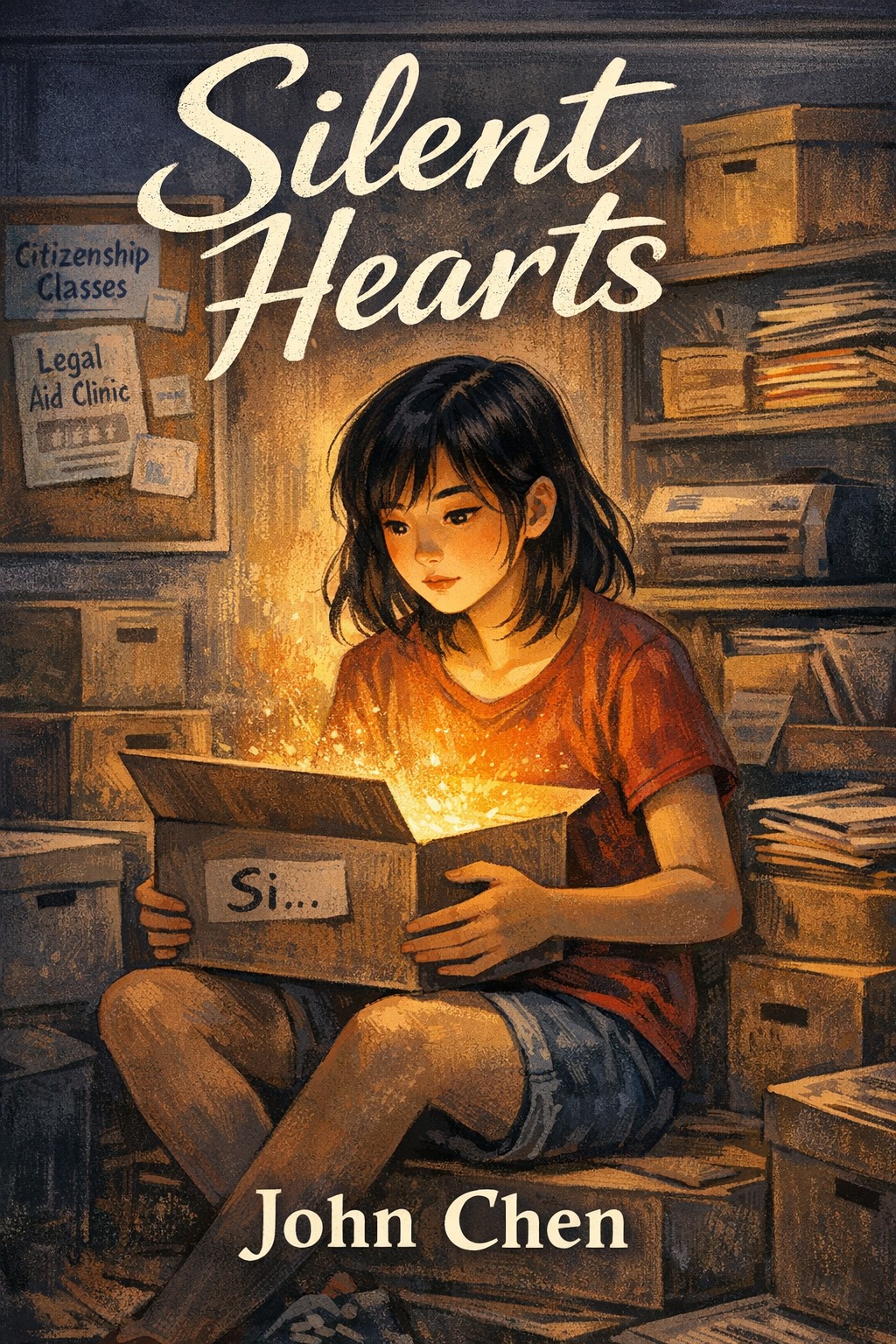
Seventeen-year-old Ruthie Kao spends the first blistering week of summer in the storage room above a shuttered legal aid clinic in Seattle, cataloging old case files for her mom. In the back, behind flyers for free citizenship classes and a busted laminator, she finds a cardboard shoe box labeled Silent Hearts. Inside are cassettes recorded on a battered Walkman: messages in Taiwanese, Spanish, English, and a dozen accents Ruthie cannot place, addressed to people whose names are smudged or misspelled. Some are apologies. Some are stories. Some are just breath. Along with the tapes is a thrift-store map of the Mountain West, traced with faint pencil lines and punctured at certain towns with pinholes that glitter like constellations gone missing.
With Mateo Rocha, her best friend since sixth grade and the only person who still drives a Buick LeSabre with a cracked dash and a ceramic lucky tiger, and Dani Wu, whose hacking skills are more rumor than fact, Ruthie decides the box can't stay silent. They piece together addresses from the ledgers of a long-gone investigator, use diner wifi to cross-reference county records, and set out along I-90 with a thermos of barley tea, a bent house key that opens no door they know, and the old Walkman patched in duct tape. From Spokane's grain silos to Missoula's river bridge, from the neon bucking horse of a Sheridan motel to the wind-gnawed fence lines outside Casper, they chase the faint directions hidden in breaths and pauses. A tape labeled River 03 leads them down to the Tongue River where the air is smoke-thick with late-summer fire and where a fisherman recognizes his mother's laugh in the silt of a sentence. Another, marked Just In Case, brings them to a courthouse janitor who has kept a postcard in his pocket for twenty years.
On the road they learn what can and cannot be translated. They take back roads to avoid a checkpoint. They argue about whether a voice, once found, belongs to the person who spoke it or the world that needs to hear it. Mateo admits he might leave for El Paso at the end of summer; Dani confesses she doctored the clinic's old contact list to protect someone. Ruthie hides the fact that the first tape she played was her grandmother's, recorded in a language Ruthie understands only in fragments. Their friendship frays and knots itself again: a flat tire outside Livingston, an almost-kiss under the Fremont Bridge on a night run back to Seattle, the stubborn way they keep showing up for each other even when it would be easier not to.
The return is not triumphant so much as necessary. They bring the tapes back to where Ruthie first learned the shape of words: the damp, echoing laundry room of their Beacon Hill apartment building. They string up a bedsheet, borrow a field recorder from the community center, and invite neighbors with flyers printed in every language they can manage. The landlord grumbles about noise; an auntie passes out guava sponge cake; a kid falls asleep on a folding chair. Voices spool out into the concrete and tile: apologies, yes, and stories, but also the ordinary courage of people who kept talking when no one was paid to listen. Not every cassette finds its intended home. Not every mystery resolves. But the choice to keep the archive alive, to make a place where breath is not wasted, is theirs. In the tenderness of that decision, Ruthie understands what her grandmother was trying to tell her on that first, cracked tape: that grief is a language you learn together, and love is the translation that outlives the body.