
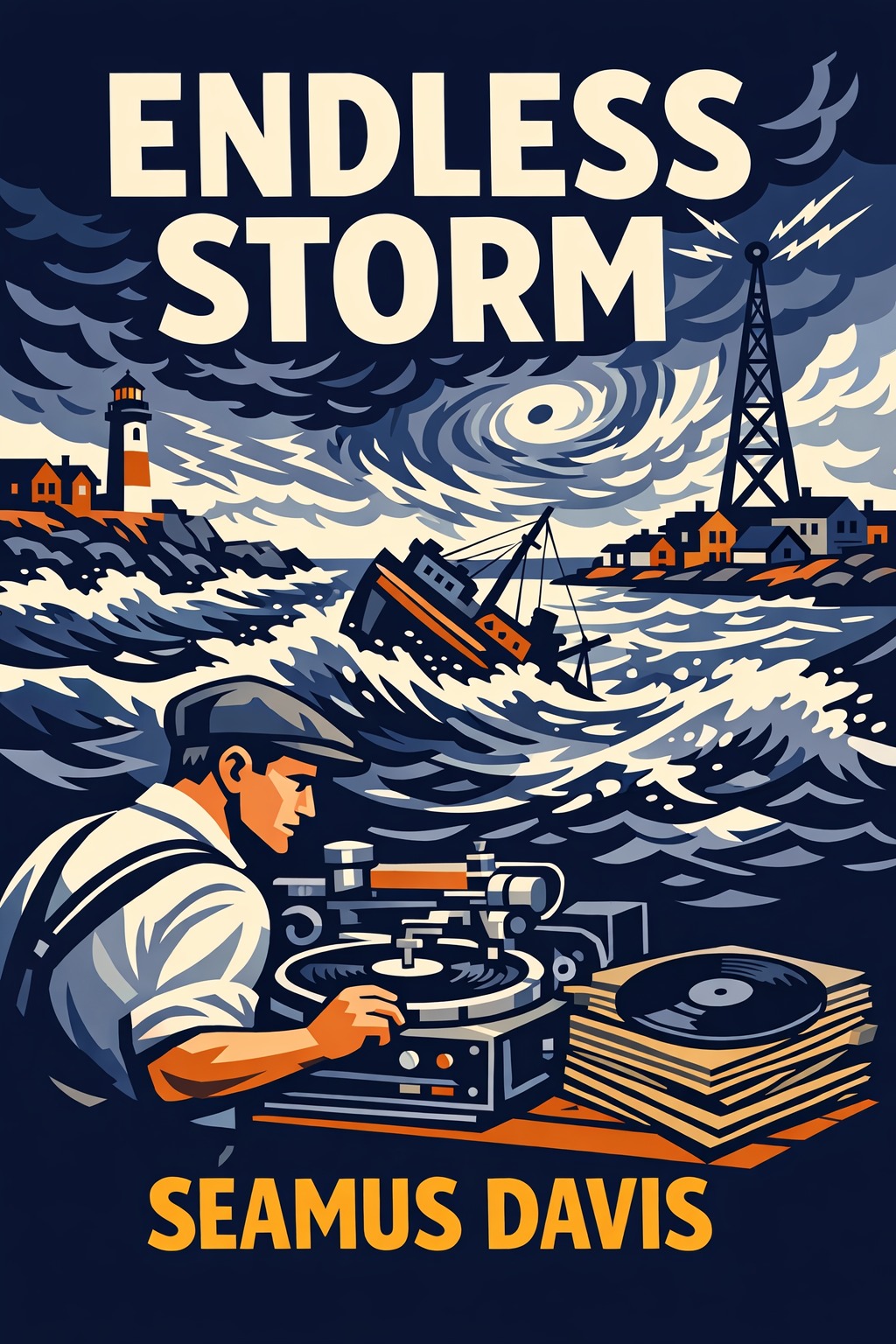
Cover of Endless Storm

Endless Storm

Historical Fiction · 304 pages · Published 2025-05-27 · Avg 3.3★ (7 reviews)

In September 1938, as the Great New England Hurricane tears along the coast, Irish immigrant and radio engineer Eamon Shaw keeps the transmitter at WCSH alive while Casco Bay turns white. When a battered Presto disc-cutter and a crate of lacquer blanks surface in a shuttered WPA office on Munjoy Hill, he and lighthouse keeper's daughter Nora Larrabee begin recording the shriek of the wind from Fort Gorges to Matinicus Rock. In the battered logbook of Nora's father and a cracked aneroid barometer, they trace the storm's impossible swings. On those midnight discs, beneath sleet and surf, something like a voice keeps counting down.

After the surge rips half the fleet from Cape Elizabeth and Biddeford Pool, three names vanish from the harbor rolls and a coroner's inquest is quietly sealed. Following the hiss and pop of their own grooves, Eamon and Nora uncover a trail of coded broadcasts, Depression-era insurance fraud, and a rumor of a prior gale in 1898 that never ended for the men who faced it. The closer they listen, the more the town's grief organizes into a pattern, a score you can touch with a needle. Endless Storm is a historical mystery about the ways we hear catastrophe, and the debts left after the wind goes still.

Seamus Davis is an Irish American horror and dark thriller writer. Born in 1984 in Derry, he studied acoustical engineering at Queen's University Belfast before moving to Toronto to work in indie film sound design. His short fiction has appeared in genre magazines and anthologies, and he has been a script consultant on several audio drama podcasts. Davis lives in Portland, Maine, where he volunteers as a coastal storm spotter and collects antique field recorders with dubious histories.

Ratings & Reviews

Janelle Kwan
2026-02-10

I came for salt-stained Maine and the intimacy of old radio, but the mystery kept elbowing its way to the front until the atmosphere thinned out. The novel keeps saying listen, and then it shouts over itself.

Compared with Ruth Moore's coastal novels and Howard Mansfield's meditations on material culture, this one leans too hard on the puzzle-box: signals here, a barometer there, a rumor pointing back to 1898. Those elements should harmonize, but the melody never settles.

Some scenes spark — the Presto cutter biting into lacquer, the transmitter humming in a whiteout — yet the connective tissue feels slack. Why are the corrugated transitions between discs, logbook, and inquest so messy when the individual beats are so precise?

It is frustrating because the ingredients are undeniably strong. I kept wanting a tide chart, not a cipher machine!

Ambition counts, and I respect the research, but the result, for me, was a persistent static that muffled what could have been a fierce, clear signal.

Gabe Lavoie
2026-01-15

I get what the book is reaching for: catastrophe as music, grief as a groove you can touch. But the thematic needle drops so often that it starts to feel like a lecture instead of a lament.

The repeated motif of "a tally that keeps counting down" could have been haunting in restraint. Instead, it clangs. Every time the discs are mentioned, the narrative insists on spelling out what absence means, what debt is owed, what the town must learn. Please, let the wind speak!

There is power in the idea that the community tries to hear its way through a disaster. Yet the coded broadcasts, the insurance grift, the rumor of an 1898 echo keep getting marshaled as proof points for the same argument, and the argument never changes.

By the end of those midnight recordings, I felt pushed rather than guided. The storm is terrifying on its own. The book does not trust us to feel it without someone telling us exactly what it signifies, and that over-explanation drowns what could have been a devastating quiet.

I wanted the theme to rise from the noise like a voice on shortwave. It arrives as an announcement, blared at full volume, and it left me cold.

Priya Menon
2025-12-02

The book excels at place. From Fort Gorges across the whitening sweep of Casco Bay to the hard light at Matinicus Rock, the coastline is rendered through sound as much as sight, which is exactly right for a story about radio and memory. The shuttered WPA office on Munjoy Hill, the cracked aneroid barometer, the station's stubborn transmitter at WCSH - these artifacts make the past hum on the page.

Stakes arrive in small, harrowing increments: boats sheared from moorings, names lost from a chalkboard, a town listening for answers in the static. It is transportive and, crucially, never romanticized.

Sofía Delgado
2025-11-18

Leí Endless Storm por su mezcla de radio e historia local.

  • Prosa tensa y técnica
  • Atmósfera costera lograda
  • Ritmo irregular en el segundo acto
  • Misterio resuelto con pistas justas

Para lectores de ficción histórica con curiosidad sonora.

Owen Parmenter
2025-09-21

Eamon's problem-solving mind is the motor here, and it is genuinely fun to watch him treat grief like a circuit he can test. Nora's presence steadies the book; she reads the sea the way he reads meters, and their clipped, practical exchanges carry a quiet tenderness that never curdles into melodrama.

The father's logbook entries lend a third voice that is salt-bitten and wary, though I wanted more of his wary humor to offset the bleakness. Even so, by the time those midnight discs start to sound like more than weather, the human stakes feel earned.

Elliot R. Sanders
2025-08-03

The novel's architecture is meticulous: studio scenes with the Presto cutter hum alongside entries from the lighthouse log and fragments of on-air patter. The author knows radio, and the tactile detail around lacquer, needles, and the hiss of shellac makes the soundscape feel tangible without becoming a manual.

That said, the braid can snag. Mid-book transitions blur time and location, and a few storm descriptions reuse the same chord progression so often that the atmospheric intensity flattens. When the structure tightens again near the inquest, the prose lifts, but I wished for a steadier hand on the dial earlier.

Marla Chen
2025-06-12

Static, sleet, and secrets power a taut hunt through 1938 Maine as Eamon and Nora chase coded broadcasts and the storm's math; it mostly works, and when the discs spin you can almost hear the town breathing.

Generated on 2026-02-14 12:03 UTC