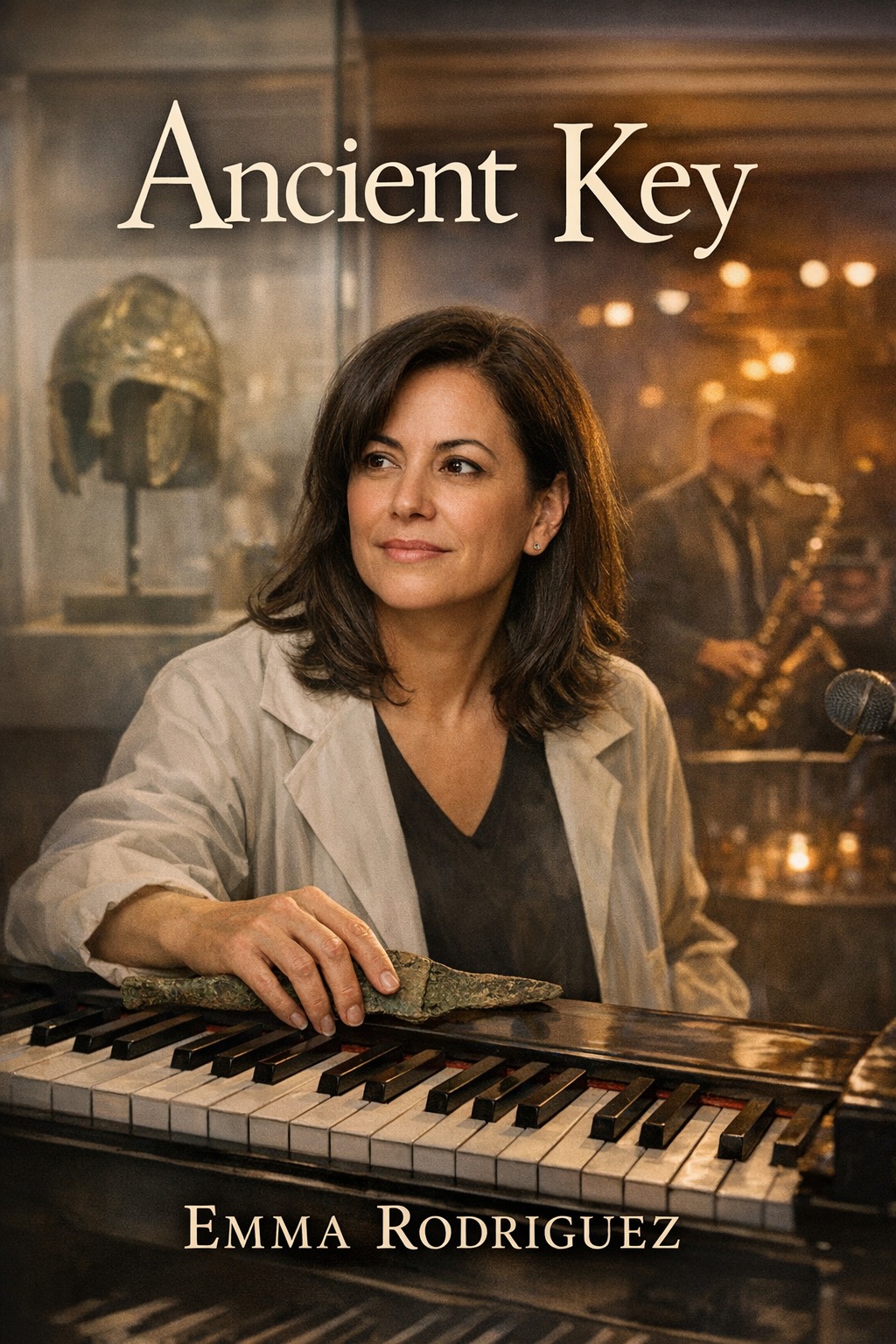
Cover of Ancient Key

Ancient Key

Biography · 352 pages · Published 2024-10-15 · Avg 4.0★ (6 reviews)

A poignant, heartfelt, and slyly funny biography of Dr. Ana Sofía Cárdenas, the conservator‑pianist who, in 2003, fused two incompatible callings—stabilizing Bronze Age instruments at the Metropolitan Museum of Art by day and leading midnight jazz sets in Greenwich Village. As news from Baghdad flickered on TVs, a battered crate from southern Iraq arrived on Fifth Avenue holding a corroded bronze tuning key, a fragment of a lyre from Ur. Cárdenas was asked to coax music from metal and history from residue.

Her days already belonged to microscopes, rabbit‑skin glue, and lab notes, but a joint project with the British Museum and the Iraq Museum raised the stakes. Nights were spoken for—Smalls, Mezzrow, and a faithful Steinway B with an action she called like walking on clouds in combat boots. Between HEPA hoods and hi‑hats, she kept time twice over, week after week.

Emma Rodriguez traces Cárdenas's nightly commute from the staff door on 82nd and Fifth to the West 4th Street station, from climate‑controlled storerooms to sweat‑warm basements where nitrile gloves gave way to callused fingers. Along that route, the ancient key became more than an object; it unlocked family stories from San Juan and Seville, a living‑room upright, and a vocation no grant proposal could explain. Interviews with bandmates Tariq Al‑Khatib and Lila Moreno, mentor Dr. Felicity Wu, luthier Hovsep Balian, curator Oded Shalem, and longtime Met guard Bobby Quintero provide a backstage chorus of skeptics and believers.

With scenes in New York, London, and Basra, and details as granular as ultrasonic baths, gum arabic, and a dog‑eared Real Book, Ancient Key renders a rare year when two stages—lab bench and bandstand—demanded everything at once. The result is an eye‑opening chronicle of creative stamina, cultural stewardship, and the odd, beautiful ways a life keeps time.

Rodriguez, Emma (b. 1986) is a journalist and biographer from San Antonio, Texas, based in Brooklyn. A graduate of the University of Texas at Austin and Columbia Journalism School, she has profiled artists, scientists, and museum conservators for outlets including Smithsonian, Texas Monthly, and the Los Angeles Review of Books. Her previous biography, The Quiet Frame, explored photographer Celia Navarro's borderland work and was named a best nonfiction title of the year by several regional newspapers. Rodriguez has held residencies at MacDowell and Ucross and teaches narrative nonfiction at CUNY's Craig Newmark Graduate School of Journalism.

Ratings & Reviews

Rowan McAllister
2026-02-10

If Paul Berliner's Thinking in Jazz had a quiet conversation with a museum conservation handbook, you would get something like this. Rodriguez writes for readers who enjoy craft on the page, whether that's voicing a chord at Smalls or coaxing stubborn patina into disclosure at a lab bench.

For musicians, the club scenes feel lived-in; for museum folks, the casework ethics are handled with care. It's a niche-crossing biography that rewards patience and close listening.

Jamal Noor
2026-01-20

Worlds touch without spectacle here. We move from climate-controlled storerooms to sweat-warm basements, from London loan meetings to a late Basra thread that never feels like scenery. The lyre fragment from Ur is not a prop; it is a stubborn presence that insists on patience, ethics, and listening.

Basra hums underneath every careful swab.

Rodriguez makes the Met hallways and West 4th station feel like adjacent corridors of the same labyrinth, and the stakes stay human-scale: safeguard an object, honor a lineage, make the night's set mean something. The global institutions hover, but the book's atmosphere is built from nitrile, bronze, steam, and blue notes.

Priya Menon
2025-12-01

I finished Ancient Key with my pulse quietly syncopated. Emma Rodriguez locates surprise in glue pots, TV war tickers, and a midnight Steinway, and the result is joyous and tender.

What moved me most is how the book treats vocation as a rhythm you learn by listening. Ana Sofía Cárdenas keeps faith with the fragment and the set list, and Rodriguez frames that with humility and spark. At one point she writes that "two stages, lab bench and bandstand, demanded everything at once"; the book never lets that chord resolve too easily, and that tension sings.

Details land like notes you can hear: ultrasonic baths humming beside gum arabic and rabbit-skin glue; HEPA hoods giving way to club air; the battered bronze key from Ur slowly revealing a history as she commutes from 82nd and Fifth to West 4th for Smalls and Mezzrow. The British Museum and Iraq Museum collaboration adds gravity without stealing the groove, and the Real Book is as present as any archive.

By the last pages I had goosebumps, not because anything explodes, but because care itself becomes percussive. This is a biography that keeps time with responsibility and delight, and it swings.

Eliza K. Duarte
2025-06-07

A steady, thoughtful biography with some pacing hiccups.

  • Meticulous conservation scenes
  • Occasional time jumps that blur momentum
  • Bandmate interviews that glow then vanish too quickly

I admired the specificity around ultrasonic baths and adhesives, and I liked the club vignettes, but the yearlong arc sometimes reads like linked essays rather than a rising line. Still, fans of process-heavy narratives will find plenty to savor.

Lucia Valdés
2025-02-18

Lo mejor de este libro es la interioridad de Cárdenas: su oído entrenado para detectar una vibración en metal corroido y, a la vez, el pulso íntimo que busca en la medianoche del Village. Las conversaciones con Tariq Al‑Khatib y Lila Moreno no son adornos; revelan dudas, códigos de banda y pequeñas ternuras que iluminan a la protagonista sin idealizarla.

Rodriguez capta voces distintas con gracia, especialmente la de un guardia del Met que aporta humor cansado. Si a veces la contención emocional enfría una escena, compensa con momentos donde una nota sostenida o un olor a goma arábiga bastan para contar una vida.

Thomas Greer
2024-11-02

Rodriguez structures the year like a setlist with reprises, and it works. The prose has two tempos: patient reportage in the lab, crisp syncopation in the clubs, with chapter breaks that feel like breath marks rather than cliffhangers. A few transitions from microscope notes to rehearsal chatter are abrupt, but the author's control of technical language and scene-setting keeps the narrative clear, specific, and quietly propulsive.

Generated on 2026-02-13 12:03 UTC