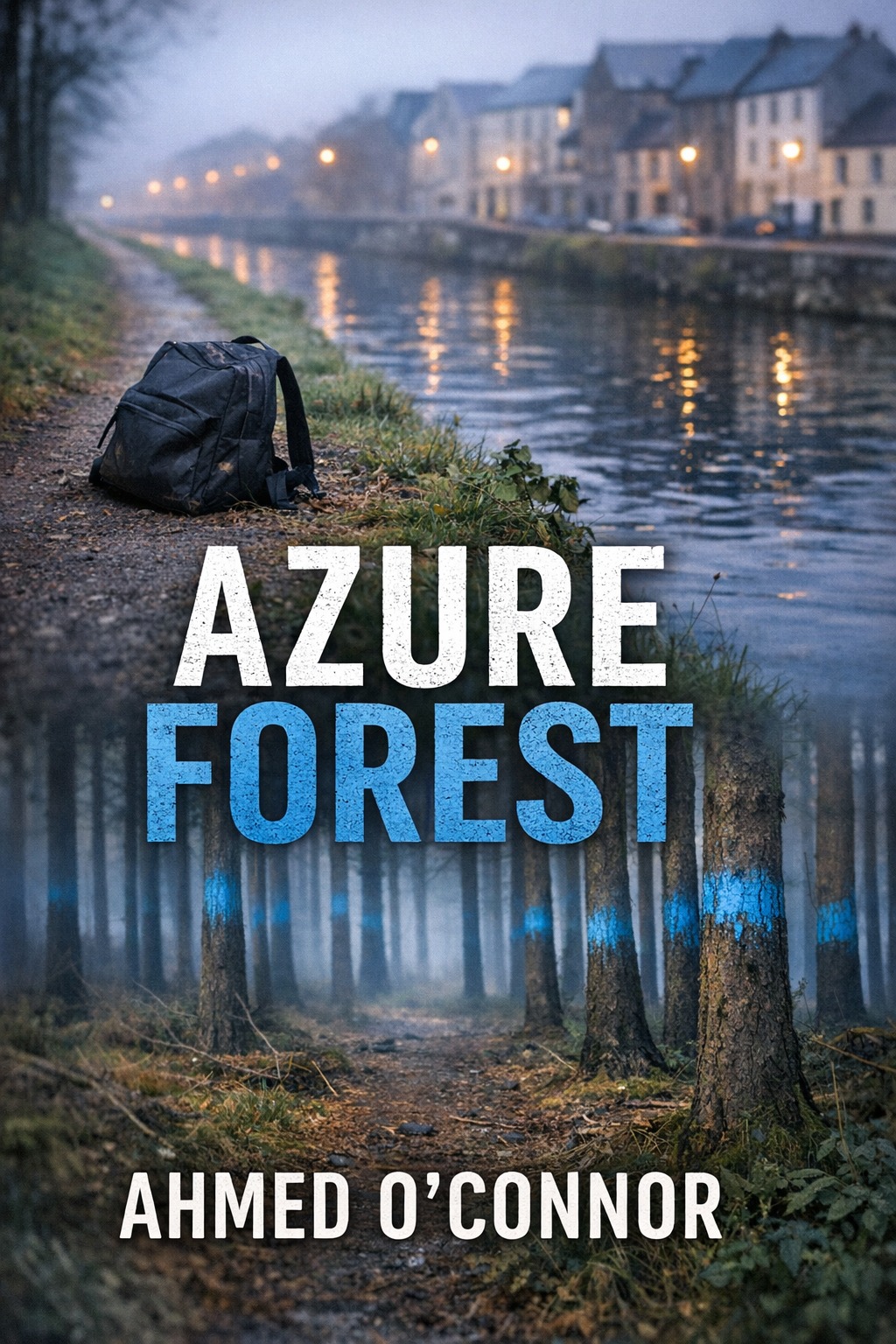
An empty backpack on the canal towpath in Galway, blue spray on the trunks of a plantation outside Gort, and a name that sounds like a promise: Azure Forest. Keelin O'Dea, a community archivist who has spent years coaxing stories from damp cassette tapes and reluctant elders, is ordered to take leave after a public row with a wealthy donor who wanted a testimony excised. Bruised by the reprimand and the quiet politics of memory, she hears a frantic voice note just after midnight from Blessing Okoye, a former participant in her oral‑history workshops, now working as a junior surveyor for a carbon-offset forestry firm. Blessing says she has a little boy, that a white pickup has followed her for days, that the blue marks on the trees are not random.
When Blessing vanishes, Keelin finds only a battered survey stake wrapped with blue tape, a laminated grid listing Compartment 17B, and a microSD card stuffed into a matchbox: digitised reels labelled Coill Gorm, 1982. The recordings speak of a sawmill accident, a missing ledger, and timber lorries that drove at night along the back roads above Lough Derg. They name names—O'Malley Timber, a councillor called Fiach O'Malley, a security contractor set up by veterans fresh home from UN tours.
Following OS maps and the voices of the dead, Keelin drives the forestry roads of the Slieve Aughty, past shuttered hardware stores in Scarriff and a filling station in Portumna where the diesel pumps are chained at dusk. Azure Forest, a glossy rewilding partnership with ÉireCarbon plc, has fenced the old commonage and posted wardens with radios. The Gardaí prefer not to get drawn in. Locals close their doors. In the gaps, people get lost.
A war is brewing between a loose Freeholders Association who insist on ancient grazing rights and a ruthless security outfit led by Niall Broderick, a former sergeant who teaches night classes in perimeter control and calls it community safety. Checkpoints flower at gates. Wind turbines are sabotaged. Rock salt goes into diesel tanks. In the middle are migrant workers without papers—Filip Stancu among them—and Blessing's toddler, left with a neighbour who will not answer the bell.
Keelin risks everything she thinks she knows about keeping records and staying neutral. She uses her archive pass to pull a bound volume of minutes from a company basement in Ennis, takes a secretive meeting in a boarded-up parish hall, and follows the tapes to a decommissioned Bord na Móna yard near Whitegate, where pallets are stacked to hide a container with a false wall. The blue-marked trees form a perimeter. There is a shotgun in the back of a gator, a box of children's shoes, a carbon-credit ledger with two sets of names. An old sawyer's story about an arms cache sunk in a bog turns, abruptly, into a map.
The west keeps its own archives—in peat, in water, in people. As fog lifts off Lough Graney and the radios crackle in the undergrowth, Keelin must decide what kind of witness she is, and how far she will go for Blessing and the boy. Azure Forest promised restoration; what it shelters is older and more ruthless than any planting plan.