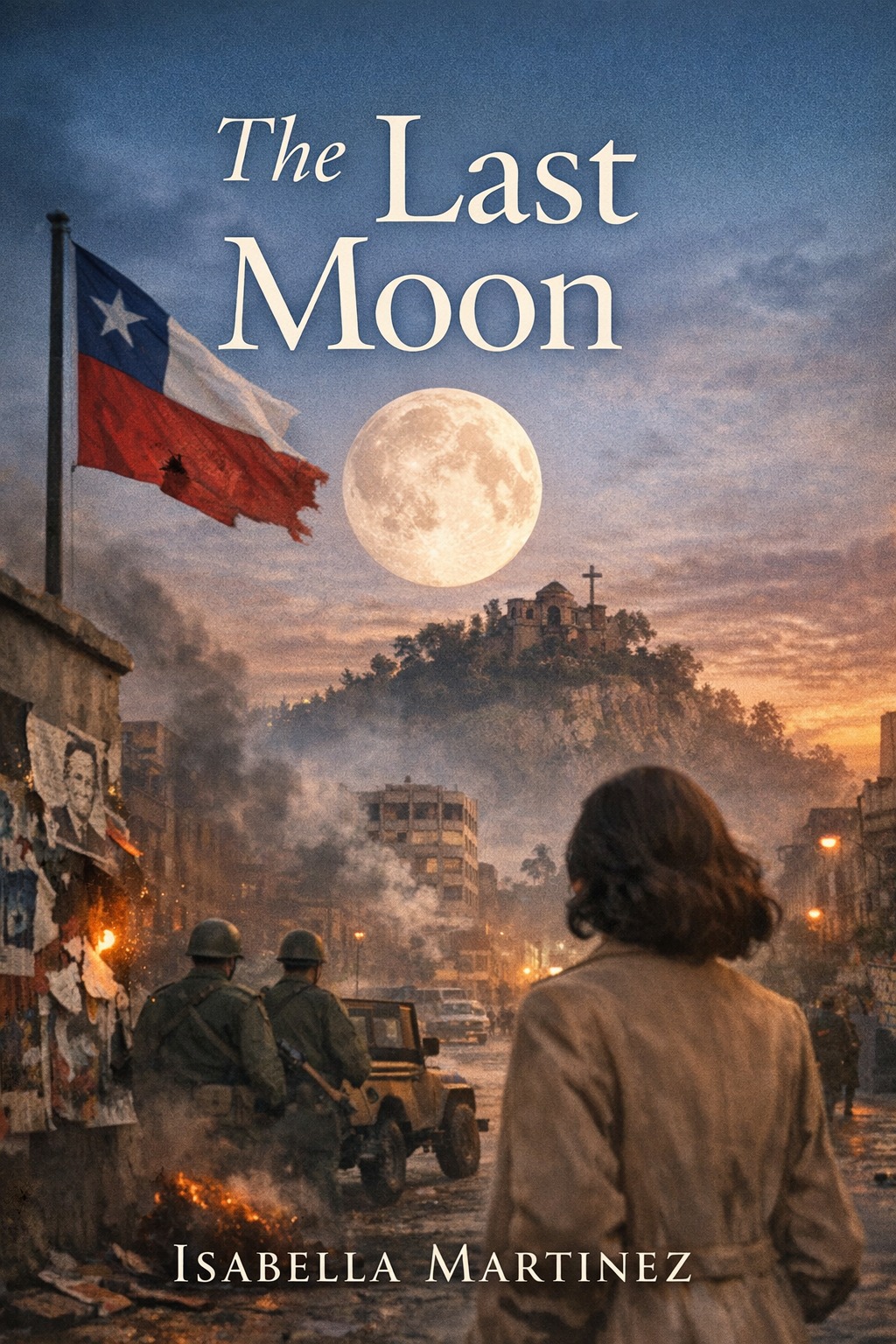
Cover of The Last Moon

The Last Moon

Historical Fiction · 384 pages · Published 2019-08-13 · Avg 3.5★ (6 reviews)

Curator's note: An alternate jacket design is known to circulate.

It is September 1973. Santiago, Chile. The streets hold their breath. Sirens splice the morning; posters curl and blacken; radios fall to static. Over Cerro Santa Lucía, the last clear moon hangs like a witness no one invited.

At a vigil in a candlelit apartment on Calle Agustinas, fifteen-year-old Paloma Ibarra slips her hand into her father's wool coat and feels a hard edge sewn into the lining: a cassette tape, unmarked, its reels gleaming like two pale eyes. On it is the banned voice of the vanished poet Álvaro Salcedo, reading verses never printed. What begins as a rescue becomes a devotion. With the guidance of Don Abel, a night-shift janitor who coaxes songs from a battered bandoneón and keeps a dusty Remington upright in his closet, Paloma learns to thread words through machines.

By dusk she pedals a footpress in a hidden back room off the Mercado Central, striking broadsides on onion-skin paper; by dawn she tucks slivers of poems into loaves from Panadería Sol, hides spools in hollowed-out soap. She scavenges melodies from scorched sheet music at the Conservatorio, maps silence along the Mapocho, and memorizes which windows stay dark when trucks prowl.

Then the knock that redefines a life: her mother shelters Tomás Quiroga, a longshoreman with names in a notebook and a bullet graze under gauze, beneath their loose kitchen tiles. Paloma's city unfurls and shutters at once. Under curfew, under whispers, under that unblinking moon, she must decide what a voice is worth, and how far a handful of paper can travel against a night that will not end.

Martinez, Isabella is a Chilean American novelist and translator. Born in 1983 in El Paso, Texas, to parents who left Valparaiso in the late 1970s, she studied Latin American history at the University of Texas at Austin and earned an MFA in fiction from the University of Iowa. Her essays and short stories have appeared in Agni, Zyzzyva, and Kenyon Review. A former Fulbright researcher in Santiago, she has worked as an oral history interviewer in Buenos Aires and as a high school teacher on the U.S.-Mexico border. She lives in Oakland, California, where she co-directs a community press and teaches archival storytelling workshops.

Ratings & Reviews

Rocío Valdés
2024-05-12

Para lectores de ficción histórica que buscan lirismo y un pulso íntimo en escenarios urbanos. Recomendable para clubes de lectura interesados en Chile de los 70 y en relatos sobre arte clandestino.

Notas de contenido: golpe de Estado, detenciones, disparos a distancia, desaparición sugerida, allanamientos nocturnos, amenazas. Público sugerido: 16+ por temática, lenguaje poético denso y momentos de tensión sostenida.

Camila Orton
2023-09-22

The book treats voice as contraband and communion: cassettes, onionskin broadsides, and bread all become vessels that test how far meaning can travel before being seized. The Mapocho scenes sketch a cartography of silences, and the bandoneón threads music through absence.

What lingers is the moral calculus of risk and witness, framed by the "last clear moon" as a witness no one asked for. In that light, the novel argues that small, repeated acts of making are not ephemera but an infrastructure of care.

Anita McRae
2022-10-10

A sober, sometimes wandering chronicle of resistance.

  • Tactile printshop minutiae
  • Clear stakes under curfew
  • Midsections sag as routes repeat
  • Ending leans theme over plot
Simon Keats
2021-06-02

Paloma's fierce attention makes her believable, Don Abel mentors with weathered grace, her mother's risky tenderness reshapes the apartment's air, and Tomás, half-hidden and half-healed, sharpens their clipped exchanges into something like prayer.

Javier Santos
2020-11-30

This should have thundered; instead it hummed, distant and polite.

I kept hoping for the nervy compression of Soot and Melodies by Clara Piñeiro or the braided urgency of The Quiet Leaflets by Mateo Ríos, but the narrative drifts.

The imagery turns into fog at crucial moments, with metaphors stacked like sandbags where momentum should be. The cassette becomes an all-purpose halo, and scenes of waiting replace scenes of choice far too often.

Yes, there are flashes: the bandoneón in the dark apartment, the Remington's clack, the market's hidden room breathing like a second lung.

But tension barely escalates, routes repeat, and the moon motif is pressed again and again until it feels like stamp duty rather than insight.

I respect the subject, I admire the intent, but the execution left me outside the apartment door, ears full of static.

Mara Delgado
2020-01-15

The novel's architecture tracks days compressed by curfew and nights opening into workrooms; chapters pivot on machinery, light, and radio static. Paloma's apprenticeship is paced with patience, and the typesetting and footpress scenes click with tactile clarity.

Sometimes the lyricism stacks too many metaphors on a single page, muting urgency, but the compositional restraint in key moments, like the silent pedal strokes before dawn, keeps the story taut enough.

Generated on 2026-02-09 12:03 UTC