
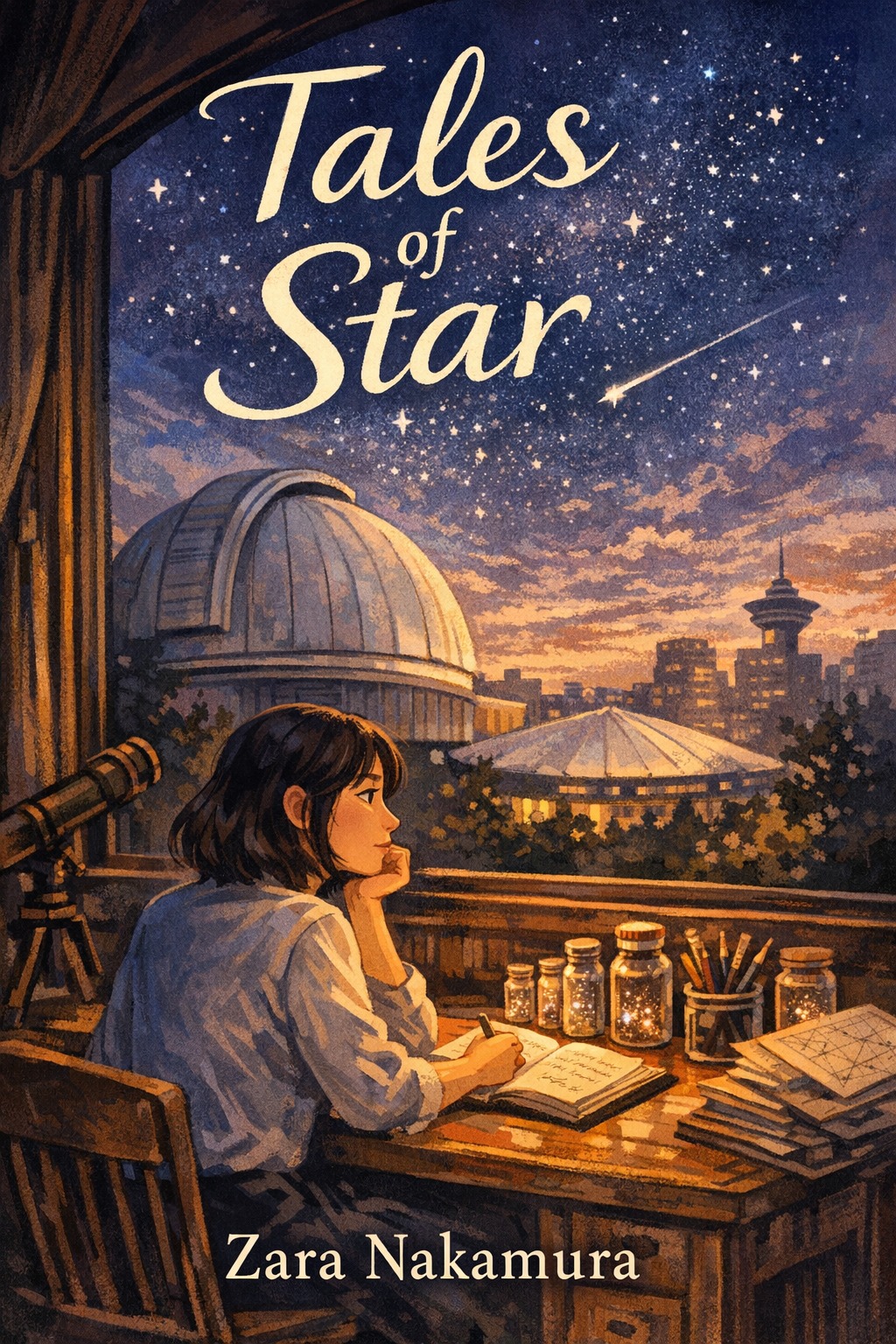
Cover of Tales of Star

Tales of Star

Contemporary · 320 pages · Published 2025-08-12 · Avg 4.2★ (6 reviews)

This summer, the Hoshi Dome—the decommissioned observatory tucked beside the H.R. MacMillan Space Centre—becomes Hana Kuroda's whole universe. An ex-systems engineer turned community ecologist, Hana maintains Tales of Star, a living archive of the city: glass vials of meteor dust, paper star maps annotated in pencil, voice chips sealed into seed packets where neighbors whisper stories under Orion. Hana likes checklists, noise-canceling headphones, and the feeling of data behaving. Outside the dome, she fails to steer much of anything. Her brother Takumi pushes to sell their mother's cedar lot above Squamish. Her best friend Coral applies for a robotics job in Sapporo. And Nik Leduc, the boatbuilder hired to fix the dome's ribs, seems to be building a vocabulary of sidelong glances and unhelpful charm.

Then a freak July lightning storm fries the RFID reader that links each anonymous tale to its owner, and a wet bloom of cedar-apple rust lifts the ink right off the QR slips. The names are gone. The only way to return the star-stories is to open them. As Hana and Nik listen and read—on the ferry to Bowen Island, under a tarp while Pacific wrens heckle them, down in the cool of the Hoshi Dome—secrets drift loose: a pipeline deal signed behind a Chinatown bakery, a love letter folded into a tide chart, LiDAR prints proving an old-growth stand someone pretended wasn't there. The archive tilts into color and chaos. For a woman who has only trusted isolated systems, Hana begins to let the network do what forests do: connect and redistribute. Summer in Vancouver sharpens; the projector hums back to life; and with the least predictable ally at her side, she learns that surrender can be a kind of navigation.

Zara Nakamura is a Japanese–New Zealander science fiction writer and forest ecologist. Born in 1986 in Sapporo and raised in Auckland, she studied ecology and computer science at the University of Auckland and completed a master's on fungal communication networks. She worked on LiDAR canopy surveys in British Columbia and later as a systems engineer for an orbital agriculture startup in Tokyo. Her short fiction has appeared in Clarkesworld, Lightspeed, and Shoreline of Infinity, and her work has been shortlisted for the Sir Julius Vogel Award. She lives in Vancouver, British Columbia.

Ratings & Reviews

Thomas A. Greer
2026-02-03

Recommended for readers of quiet eco-centric contemporary fiction with a gentle romantic thread. The archival conceit is inventive and the Vancouver atmosphere is palpable, but the measured pacing will reward patience more than urgency.

Content notes include storms, corporate pressure regarding land use, and community tensions around environmental harm. Adult, but accessible to mature teens who appreciate reflective storytelling.

Leonie Krishnan
2026-01-09

The book keeps tracing how systems shape care, and how care reshapes systems. When the labels burn out, the city stops being data points and becomes relationship: neighbors' voices in seeds, tide charts folded around longing, maps smudged by weather and touch. It all crescendos into the idea that "surrender can be a kind of navigation," and the story earns that claim by letting uncertainty feed community rather than fear.

Sergio Valdés
2025-12-15

Vancouver en verano brilla sin artificio, con el Hoshi Dome desmantelado, los viales de polvo meteórico, los mapas de estrellas con lápiz y esas semillas con chips donde la ciudad guarda susurros. El libro convierte esos objetos en un sistema vivo que respira con lluvia, ferries y el crujido de madera en reparación. Las revelaciones no son trucos sino ecos de un tejido comunitario que se resiste a ser simplificado. Mar, bosque, óxido de cedro manzano, impresiones LiDAR, un trato de tubería detrás de una panadería de Chinatown, una carta en una tabla de mareas. La geografía se vuelve ética. Hermoso y preciso.

Rosa Anne Blake
2025-11-02

I am buzzing. This book found the signal in the noise of my own brain and turned it up. Hana's impulse to catalog and contain is portrayed with such care that I kept stopping to breathe and nod. The dome, the seed packets, the pencil marks on maps — every tool is a mirror.

What moved me most is how the story lets Hana change without punishing who she has been. She is exacting, she is protective of data, and she is scared of letting the network speak back. Watching her choose connection, thread by thread, felt like watching someone learn a new language and use it to say thank you.

Nik's presence is a gentle catalyst, never a bulldozer, and that restraint is electric. The sidelong glances, the tarp in the rain, the ferry rides — chemistry rendered as shared attention rather than fireworks. I yelled yes into the quiet more than once.

By the time the projector hums again, the city has become chorus, not backdrop. Absolutely glorious, tender, generous. Five shining stars.

Elliot K. Zhao
2025-09-10

The line-level precision meets a modular architecture that mirrors Hana's training, with diagrams of thought and meticulous checklists gradually giving way to warmer, messier field notes. The chapters sort evidence the way an engineer would: checklists that tighten into feeling. The pace hums at a low frequency until the storm, then widens into attentive listening as the archive is reopened and returned.

Mara Jensen
2025-08-23

After lightning scrambles the archive, Hana and Nik move with steady urgency from ferry benches to the Hoshi Dome's cool floor, solving a summer of lost stories without rushing the breath between scenes.

Generated on 2026-02-06 12:03 UTC