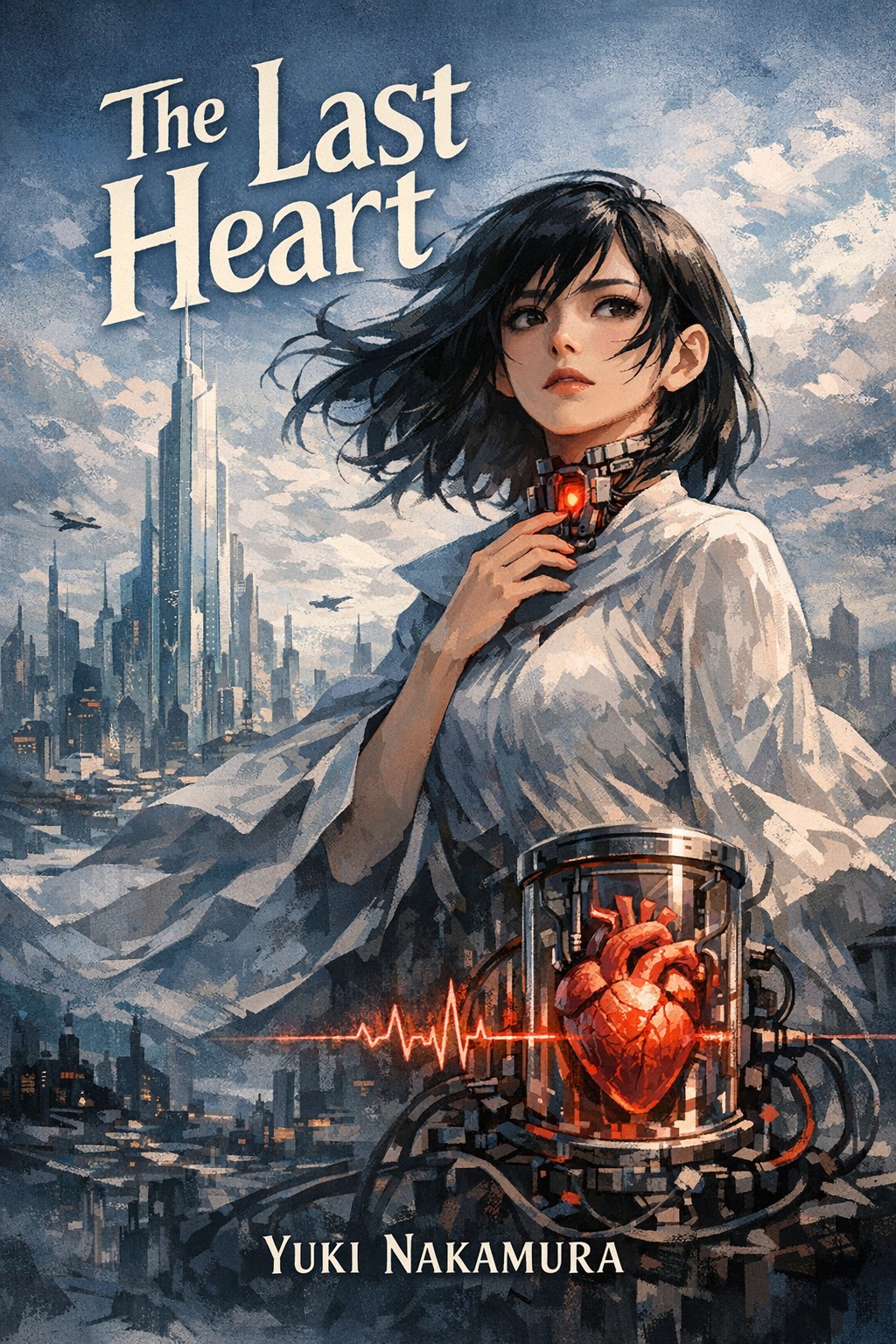
Cover of The Last Heart

The Last Heart

Graphic Novels · 224 pages · Published 2024-05-07 · Avg 3.8★ (6 reviews)

Most legends end the moment a heartbeat is saved—but this is no legend.

Shiori Azuma, daughter of the inscrutable Chairman Azuma, lives high above Kuro City in the mirrored hush of Hiragi Spire. A surgical graft in her throat left her words snagged and breathy, and the Chairman would rather keep a glitching voice out of the family's glossy advertisements. When a backroom deal threatens to crack the Azuma monopoly, Shiori is hurried into a contract-bond with Ren Kirisame, a lowborn field medic from Rust Harbor whose fists and exacting hands made him indispensable to the company's shadow crews. Their union is little more than signatures and a flash of cameras; her halting greetings fall between panels, his answers are a single nod and a turned shoulder. By dawn Ren is gone—shipped to the Emberline Front, where bodies are stitched with wire and rumor.

Three years and a dozen sieges later, Ren returns wearing the city's medals and the nickname Lockbreaker, a war-hero who knows how to make machines obey. Whispers coil through tea stalls and tram-cars that Ariadne Senda, the radiant bioengineer of Bell Tower Hospital, offered him a merger that could rewrite his station. Yet when Ren steps from an ink-black Kurokasa tram into Hiragi Spire, his gaze does not climb toward Ariadne's laboratories. He has come for Shiori, eyes bright with a patience that burns hotter than any neon.

Drawn into Verdigris Market and the floodlit warrens beneath Tenrai Bridge, Shiori learns to lace her stutter into rhythm, to rebuild breath with a ceramic pacer, and to read the city's pulse-lines like notation. As the Chairman maneuvers to bury old mistakes, Shiori and Ren discover the vault beneath the river where a single unaugmented organ—Kuro's last living heart—throbs in a cradle of glass and brine, its beat synced to the city's power grid. Saving it could topple a dynasty. Breaking it could quiet every voice.

Rendered in brushy graphite and washes of rusted gold, The Last Heart moves between silent, lingering panels and sudden, kinetic spreads: rooftop duels along cable-tethers, hospital corridors humming with phosphor light, an alley shrine of torn ribbon prayers. It is a romance sharpened by steel and steam, where courage is learned, not granted, and where a voice—however fractured—can turn a metropolis. This volume collects Chapters 1–14 of the original serial.

Nakamura Yuki is a Japanese cartoonist and illustrator born in 1989 in Fukuoka Prefecture. After studying sequential art and printmaking at Kyoto Seika University, Nakamura worked in Osaka as a background and tone assistant for small studio projects before self-publishing mini-comics that blended industrial landscapes with intimate character studies. Their breakout independent novella Quiet Harbor and the risograph series Railskin earned a devoted following in Tokyo's zine scene. Nakamura's work is known for layered textures, restrained dialogue, and a focus on resilience in liminal cities. They co-founded the small press Plover Room in 2021 and teach weekend comics workshops in Koenji, Tokyo.

Ratings & Reviews

Amina Khalil
2026-01-12

Steel, steam, and a soft-spoken romance coil through gorgeous graphite, delivering a moody first volume that hums with risk and tenderness.

Hyejin Park
2025-06-22

Azuma's city runs on bodies and belief, and the book keeps returning to agency: voice as technology and self. The panels teach Shiori to breathe on her terms, while Ren chooses patience over swagger, which reframes heroism as a discipline.

The motif that hooked me is simple and huge, stated near the start as "Most legends end when a heartbeat is saved." This story asks what comes after, when care becomes rebellion and love becomes infrastructure. The answer is not tidy, but it resonates.

Priya Calder
2025-01-03

Kuro City is a living instrument and I wanted to press my ear to every panel. The Hiragi Spire mirrors, Verdigris Market haggles in light, and the warrens under Tenrai Bridge hum like low drums.

The art does something electric with space. Floodlit corridors throb, alley shrines sprout torn ribbon prayers, and the river vault sits like a cathedral of brine where one impossible organ keeps time with the grid.

Every artifact feels used. Cable-tethers scuff rooftops, tram windows hold whispers, and that ceramic pacer turns breath into code. I could taste iron and salt and graphite dust.

Worldbuilding this layered usually gets chatty, but here the city explains itself through signage, posture, and shadow. When rumor from the Emberline Front pours back into the streets, it changes how people stand.

I am exhilarated. If you read for place, this is a feast and a compass, and I am already tracing the pulse-lines in my head.

Diego Santoro
2024-09-17

Beautiful art cannot mask how the story kept slipping through my fingers.

  • Overlong siege recap sections
  • Relationship beats too elliptical
  • Intrigue threads introduced then parked
  • Lore drops that read like glossaries
Marcus Ellwood
2024-06-10

Collected here as Chapters 1–14, the book balances elegant silent gutters with sudden kinetic spreads; the rhythm is daring but not always comfortable. Scene geography sometimes smears during the bigger action pages, and a few transitions ask the reader to guess a beat that should be shown.

The brushy graphite and rusted gold palette are consistently gorgeous, and the contract-bond premise intrigues, yet the middle third bogs as it circles the monopoly plot. A strong opener that could breathe more evenly.

Lena Moriyama
2024-05-20

My chest is still humming. Shiori's snagged syllables become percussion, and Ren listens with a patience that feels like a light held steady in fog.

Their contract-bond opens on awkward silence, a flash of cameras, and the spaces between panels. Then years grind by and he returns with medals and the name Lockbreaker, but he points himself back to her without asking for anyone's permission.

The romance grows in gestures: a glove removed so a ceramic pacer can be checked, a shared tram ride where reflections do the speaking, a fight on cable-tethers that says more than a hundred declarations.

The lettering respects Shiori's breath, the graphite line falters where it hurts and sharpens where it heals. I could hear the city through the washes of rusted gold.

I am all in on this pairing, on the stubborn kind of care that builds a voice rather than speaking over it. If the rest of the series keeps this pulse, I will follow it anywhere.

Generated on 2026-01-23 12:02 UTC