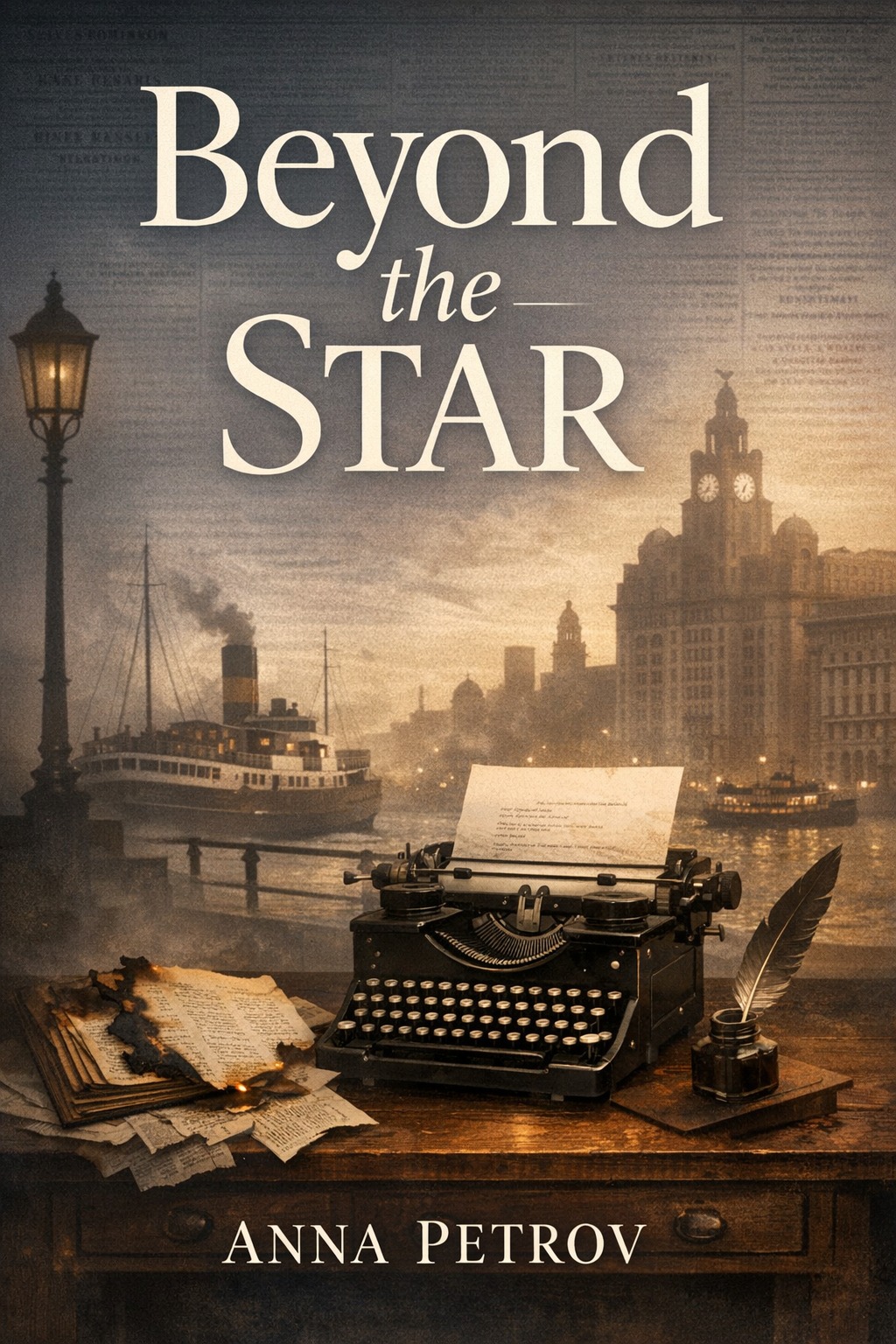
Cover of Beyond the Star

Beyond the Star

Historical Fiction · 368 pages · Published 2023-08-15 · Avg 3.7★ (6 reviews)

A typesetter in turn-of-the-century Liverpool learns to read the city's hidden messages—inked in classifieds, ferry schedules, and burned ledger pages—in a sweeping historical novel of love, peril, and the headlines that never make the press.

Liverpool, 1901. Orphaned daughter of a deckhand, Eliza Hart sets type by gaslight at the Mersey Chronicle, fingers stained with newsprint and oil from the clattering Linotype. When a stack of cryptic advertisements—initials, coordinates, odd phrases tied to the tide tables—lands on her composing stone, they point toward The Star, a notorious music hall off Scotland Road, and to Jonah Harland, a taciturn shipwright who keeps to the shadowed corners of Stanley Dock. A watch engraved with the words beyond the star, a ledger scorched in a warehouse fire along Waterloo Road, and a photograph of a lifeboat propped against a fogbound quay begin to stitch together a story the city would rather forget.

As dockers strike and the tobacco warehouse looms over the river like a fortress, Eliza navigates the reading room of the Port of Liverpool Building, back alleys that smell of salt and coal, and the gilt-and-greasepaint world behind The Star's velvet curtain. A body washes up on the Wirral sands, and whispers spread of a scuttled lighter and a bribe gone wrong. Threats slip beneath Eliza's door, and an inquest summons Jonah by name. Drawn to a man built of silence and splinters, Eliza must decide how much truth she can set in type—and whether the path beyond the Star leads to a future or to the river's dark pull.

Petrov, Anna (b. 1985) is a Russian-born British novelist and former archivist whose work explores women's labor, migration, and the machinery of modern cities. Raised in Nizhny Novgorod and Hull, she studied history at the University of Leeds and earned an MA in public history from Royal Holloway. From 2010 to 2016 she worked in the archives of the Merseyside Maritime Museum, cataloging ship manifests, dock plans, and immigration records; later she taught part-time in adult education while researching industrial-era Britain. Her short fiction has appeared in small journals devoted to place and history, and she has been awarded regional fellowships for emerging writers. Petrov lives in Bristol with her partner, a teacher, and a retired greyhound, and she spends far too much time in reading rooms and on night ferries taking notes in pencil.

Ratings & Reviews

Serena Valdez
2026-01-12

I admired the ambition but struggled with execution.

  • Murky stakes in the early third
  • Repetitive clues around the classifieds
  • Tension dips after the body on the Wirral
  • Jonah stays too opaque for too long
Gareth O'Rourke
2025-10-11

Beyond the obvious mystery, this is a meditation on labor, censorship, and how cities hide their wounds. It asks a timeless question: what price truth when a bribe can buy silence, and when love tempts you past the marquee's light toward "the river's pull".

Rosa Mendel
2025-01-22

Gaslit composing rooms, the tobacco warehouse looming like a fortress, ferry clocks ticking in the Port of Liverpool Building, and the greasy glitter of The Star combine into a city you can smell, hear, and almost touch.

Eilidh Carver
2024-07-05

Eliza's voice is tough, wry, and attentive. Her bond with the machines feels as lived-in as her wariness around the docks.

Jonah, all splinters and guarded gestures, opens slowly through small acts rather than speeches, which makes their connection believable. Dialogues behind the velvet curtain crackle with class and survival, and even side figures at the Chronicle carry a distinct rhythm.

Martin Adeyemi
2024-02-14

The prose has a typesetter's precision, full of spatter and ink, but the cadence sometimes stalls as we move from the composing room to the music hall. Chapters close on elegant images, then reopen elsewhere with a jolt, which left me reorienting more than I wanted.

Still, the structural motif of messages hidden in advertisements and schedules is smartly threaded, and the recurring objects (the watch, the scorched ledger, the foggy photograph) provide a tactile spine. Trim a scene or two around the inquest prep and this would sing.

Carla Whitby
2023-09-02

Eliza's hunt through classifieds, tide tables, and warehouse ash becomes a taut mosaic of clues that clicks with the dockside unrest. A few transitions between the Chronicle and The Star feel abrupt, but the momentum holds.

Generated on 2026-01-18 12:02 UTC