
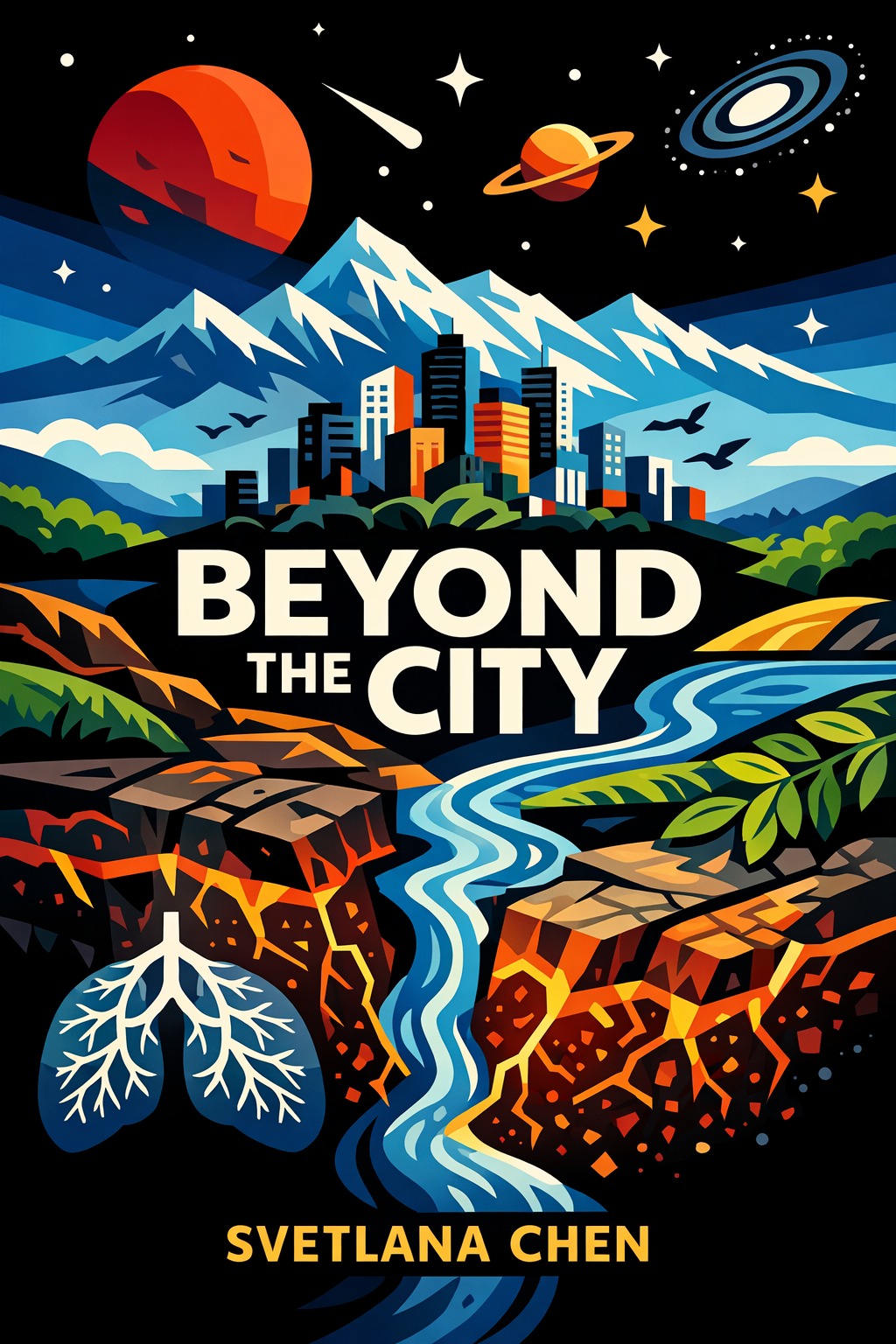
Cover of Beyond the City

Beyond the City

Science · 224 pages · Published 2024-05-07 · Avg 3.8★ (6 reviews)

What is a city when measured against tectonic plates and starfields? How do our streets, lungs, and rivers braid with the planet's physics? How does the wider biosphere write itself into our daily commute? There's no steadier guide through these urban-scale mysteries than scientist and data storyteller Svetlana Chen, who follows signals from the Keeling Curve atop Mauna Loa to night-sky brightness over Nairobi and Seoul. Yet most of us have little time to parse journal articles between emails and errands. So Chen distills climate, materials, and astronomy into crisp, witty microchapters you can finish on a train—heat islands mapped by drones above Phoenix, an accelerometer taped to a skateboard in São Paulo, wastewater RNA in Stockholm, GPS clocks ticking beneath the streets of Tokyo, and a kitchen spectroscope splitting LED light in Shenzhen.

Svetlana Chen is a physicist and urban systems researcher whose work bridges atmospheric science and everyday infrastructure. Raised in Vladivostok and Vancouver, she earned a BSc in physics from the University of British Columbia (2005) and a PhD in atmospheric physics from the University of Chicago (2012). After postdoctoral research with NOAA's Earth System Research Laboratories, she led an urban data group at the Singapore-MIT Alliance for Research and Technology and later founded OpenTerrace, a nonprofit supporting community environmental sensing. Since 2020 she has served as an associate professor at the University of Toronto's School of Cities and Department of Physics, focusing on urban heat fluxes, low-cost spectrometry, and timekeeping networks. Her fieldwork has logged rooftop temperatures in Phoenix, mapped light pollution in Seoul, and collaborated with UN-Habitat on public night-sky initiatives. Her essays have appeared in Nature, Wired, and Aeon.

Ratings & Reviews

Ibrahim Noor
2025-11-18

This is as much about the scientist as the science. Chen's persona is curious, gently self-deprecating, and stubborn about measurement. You can hear it when she tapes an accelerometer to a skateboard or splits LED light at her kitchen table.

She never turns the city into a morality play, which keeps trust high even when conclusions are tentative. I wanted more about moments of doubt, but as a guide she's companionable and exacting.

Theo Kwan
2025-06-07

If you enjoy Geoff Manaugh's speculative urbanism and James Bridle's systems thinking, this scratches the same itch while staying grounded in measurements. From Nairobi's dimming constellations to a kitchen spectroscope in Shenzhen, Chen makes big ideas feel neighborly. The blend of rigor and play is rare.

Celeste Moroz
2025-02-10

Chen traces the city's entanglement with planetary systems: carbon curves, night-sky brightness, and meticulously synced clocks. Her throughline is that infrastructure is a living sensor, "where streets, lungs, and rivers braid" into feedback loops we barely perceive. The best sections linger like an afterimage and recalibrate how I notice my block after sunset.

Lucía Barrenechea
2024-12-01
  • Microcapítulos ágiles y claros
  • Datos sorprendentes de Mauna Loa, brillo del cielo nocturno y relojes GPS bajo Tokio
  • Ritmo entrecortado y poco contexto para quienes recién comienzan
Ronan Chatterjee
2024-08-15

The microchapter architecture is a tidy mosaic; Chen hops from Phoenix heat drones to a skateboard accelerometer in São Paulo to wastewater RNA in Stockholm with admirable clarity. The prose is precise and often playful, but the speed means transitional tissue is thin and a few punch lines land where I hoped for connective argument.

Slow down occasionally, and the book's strong observational voice would resonate longer.

Maya Healy
2024-06-02

Chen turns cities into instruments measuring the planet. Short bursts of data and wit make me look up from the train and recalibrate the sky.

Generated on 2026-01-10 12:02 UTC