
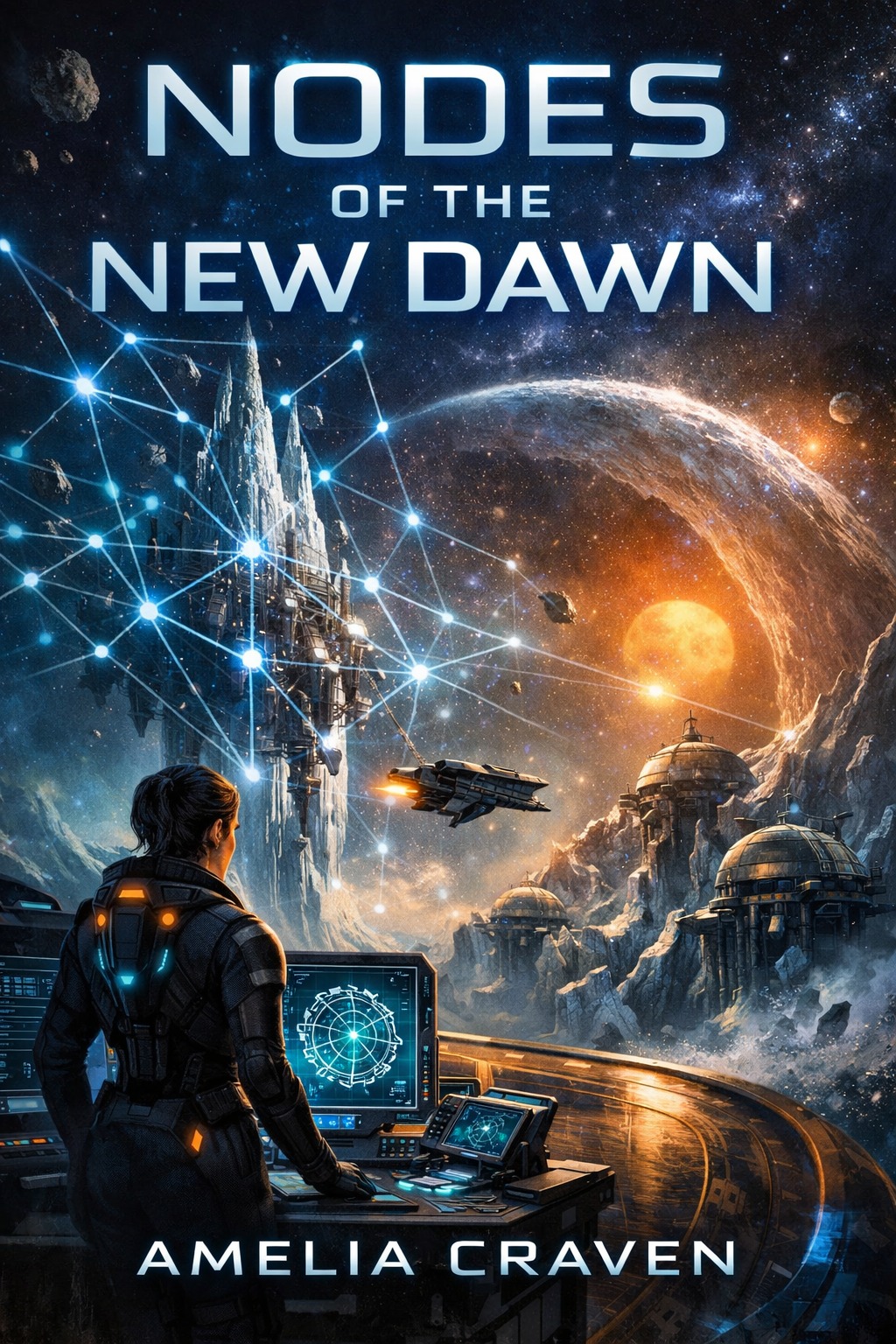
Cover of Nodes of the New Dawn

Nodes of the New Dawn

Science Fiction · 352 pages · Published 2024-06-11 · Avg 2.0★ (6 reviews)

When the solar system's century-old relay beacons—called Dawn Nodes—flicker back to life, systems engineer Mara Istrate is pulled from the quiet mines of Pallas to the Helios Gate above Mercury. The nodes broadcast a latticework of coordinates pointing toward the Kohoutek Arc, a cometary halo no one has charted, and a warning encoded in archaic Sagan-number primes. With the corporate Vitrus Council mobilizing gunships and the Freeyard Union dispatching the corvette Oriole, Mara and her crew chase the signal with a contraband muon-core and a jittery AI named Trillium.

Inside the Arc, they discover abandoned habitats stitched around ice spires, each sealed by a biotech lock that recognizes the dead. As sabotage follows them from the Seiche Basin to Ceratine Station, Mara must decode the nodes with Dr. Nkiru Ezenwa, an archaeolinguist who claims the pattern was taught to her by a vanished colony on Ganymede. The final node demands a choice: seed a newborn sun with human memory to save a dying Earth, or sever the lattice and let the unknown builders finish what they began.

Amelia Craven is a Canadian-British science fiction writer and former orbital dynamics analyst. Born in 1985 in Halifax, she studied physics at the University of Toronto and earned an MSc in space science from Imperial College London. She worked with a European satellite operations contractor from 2010 to 2016, modeling debris fields and station-keeping around Lagrange points. Her short fiction has appeared in venues such as Clarkesworld and Interzone, and her debut novel The Luminous Fold was published in 2018, followed by the novella Tidal Engines in 2021. She lives in Glasgow, where she volunteers with a community observatory and hikes the Arrochar Alps.

Ratings & Reviews

Luis Andres Cardenas
2026-01-01

By vibe it aims between Linda Nagata's procedural hardness and Gareth L. Powell's crew-centered warmth, with a dash of archival mystery. If you enjoy engineering problems and code puzzles more than layered character arcs, you may find enough to chew on, but I came away admiring the scaffolding more than the story.

Nadia Petrescu
2025-12-05

This is a book about inheritance: who gets to decide what humanity becomes. Memory is currency, grief a toolkit, and the corporate versus union conflict refracts the same dilemma at different scales. The climactic prompt to "seed a newborn sun with human memory" sets a sharp ethical hook, but the novel circles it rather than digging in, retreating to busy plot logistics and leaving the resonance thin.

Moira Kensuke
2025-08-21

The Dawn Nodes, the Kohoutek Arc, habitats stitched around ice spires, and those eerie biotech locks that recognize the dead are exactly my flavor of speculative engineering. The book sketches a solar system crowded by councils, unions, and stations with just enough texture to feel lived in. I kept wishing for a clearer sense of spatial layout when the Oriole dives through the Arc, yet the ambience of cold light and ancient infrastructure is memorable, and the stakes around that newborn sun idea are intriguingly framed.

Tariq Ben Amar
2025-03-14

Mara is introduced as a systems engineer with grit, but her interiority flickers. The book tells me she is careful, then has her leap into decisions that seem to contradict her training. Dr. Ezenwa fares better, especially when she hints at a Ganymede past, yet even those scenes tilt into lecture. Trillium gets quips, not growth, and the crew chemistry feels transactional.

I never felt the relationships cohere beyond mission logistics.

Katia Mireles
2024-09-02

I am baffled by how chaotic this book feels. The structure lurches from scene to scene with hard cuts that read like dropped frames, and the momentum never settles.

Chapters hinge on puzzle reveals about primes and coordinates, yet the payoffs are spelled out in chunky exposition. It reads like meeting notes strung into a novel. Yikes.

Trillium, the jittery AI, is teased as a personality, then relegated to announcing data. Mara's choices arrive without scaffolding, as if entire arcs happened offstage.

The prose leans on jargon, then explains the jargon two pages later. That rhythm is exhausting, and the constant terminology shifts left me rereading lines just to keep bearings.

By the time we reached the final node, I was too worn out to care. One star for a few stark images and for the core concept, but the execution is a thicket of confusion.

Jonah Velas
2024-07-10

Quick notes after finishing.

  • Swift opening at Pallas then stalls at Helios Gate
  • Cool Sagan-number breadcrumb idea, repetitive decoding beats
  • Trillium swings from jittery charm to plot device
  • Action scenes in the Arc blur, spatial cues thin
  • Big moral choice lands, but setup feels rushed
Generated on 2026-01-02 12:02 UTC