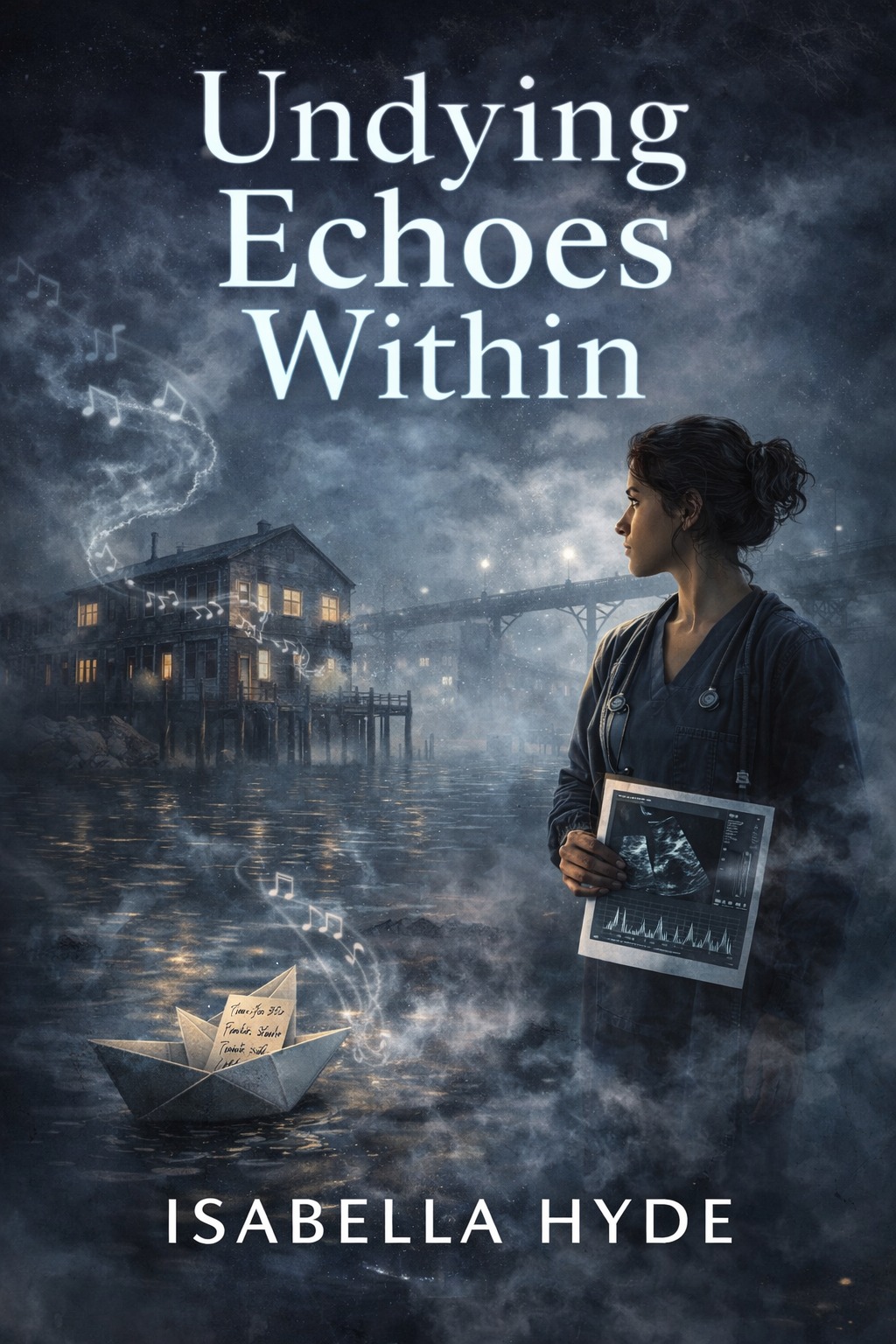
On fog-swept nights along the Providence River, cardiology sonographer Carmen Reyes swears she hears a song threaded through her patients' hearts. It is the same faint phrase of beats—an echo within an echo—appearing in scans from three tenants of a weathered wharf building in Fox Point that is weeks from being gutted and sold. The explanation on paper is artifact. In Carmen's body, where she lives by pulse and pattern, it is a message. When a note folded into an origami boat appears in her locker at Hope Street Cardiology, marked with tide times and the name of a defunct medical device company, she decides to stop being polite about coincidence.
Tamsin O'Rourke—a meticulous municipal archivist with a knack for mapping sound—meets Carmen at a neighborhood workshop on narrative medicine. Tamsin has been cataloging a hush of audio files recovered from the closed Indigo Mill: cassette tapes made by a nurse-poet who vanished after a summer storm, recordings that braid lullabies, foghorns, and whispered numbers. The same numbers surface on Carmen's printouts from a discontinued valve trial, and in chalk hearts that begin appearing on the pavement from Wickenden Street to India Point Park. Every clue pulls them closer to the same dark current: a developer's polished promise of renewal, a clinical study quietly conducted among waterfront tenants with nowhere else to go, and a pattern of failures dismissed as noise.
As hurricane season tightens its fist, Carmen and Tamsin form an unruly alliance of clinic coworkers, archivists, and stubborn longshore neighbors who refuse to vanish from the map. Their slow-burn orbit heats over late-night caldo verde in Carmen's half-packed kitchen, bike rides down the East Bay path, and the careful grammar of consent learned after losses they have not admitted out loud. Meanwhile, someone begins following Tamsin's routes, shredding cardiac tracings, and replacing labels in the archives with blank tape. Carmen's license is on the line; Tamsin's job is suddenly precarious; the tenants at Pier House face a final notice slid under every door at dawn.
During a blackout the night a storm scrapes Narragansett Bay, Carmen and Tamsin cross the city by memory and heartbeat, guided by a string of origami boats left like breadcrumbs, to the red blink of Pomham Rocks Lighthouse. In the keeper's room, they unspool the nurse's last recording and broadcast the names, invoice numbers, and timestamps the city was never meant to hear. The signal ripples across the water and through clinic corridors, cracking open a cover-up and staying an eviction by morning light.
In the aftermath, a co-op rises where the developer's showroom was meant to be. A recall notice lands like a confession. Tamsin curates an exhibit called Undying Echoes Within, where the heartbeat becomes a ledger of care instead of an asset class. Carmen learns that not all artifacts are errors; some are survivals. On the pedestrian bridge at India Point, with the tide turning below and a retired racing greyhound nosing their pockets for treats, they choose each other—slowly, fiercely, with room to breathe. Darkly witty and tender by turns, this coastal romantic suspense unspools a puzzle of class, desire, and the secret languages we carry in the body, asking what it costs to stay, and who gets to call a shoreline home.