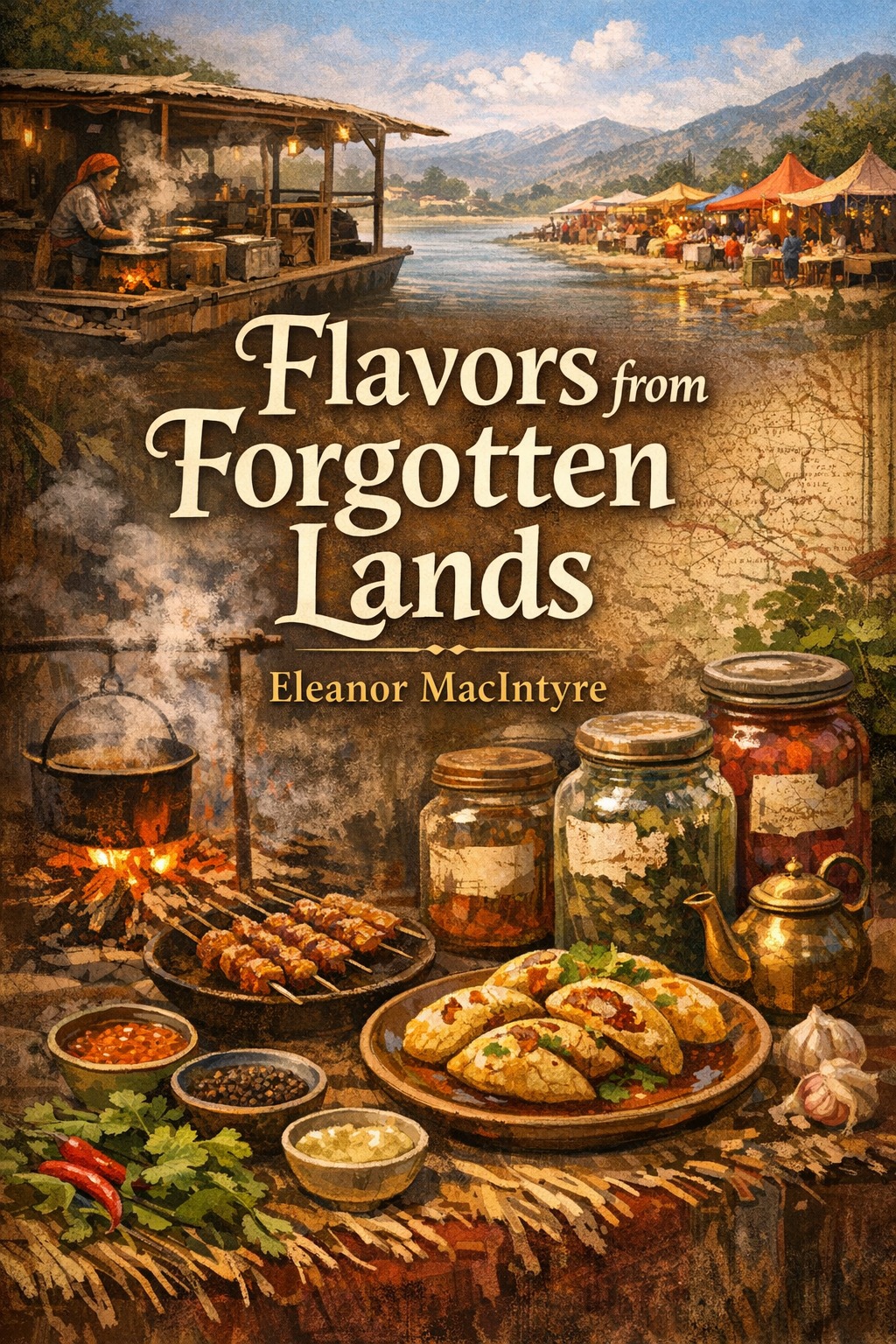
Border markets. Ferry kitchens. Wedding fires. Pantry jars whose labels have peeled away. In this roving cookbook, Eleanor MacIntyre tracks the recipes that slip between maps and memory, gathering dishes nearly erased by motorways, modernization, and the last-mile logistics of global taste. Who isn't a flavor person these days? Yet some flavors have been pushed to the edge of the plate. Here, the author brings them back to the center with an irreverent curiosity and a fieldworker's care, showing how technique, season, and place still shape what we eat even in an age of two-hour delivery.
From peat-reeked coastlines to mountain terraces, each chapter marries story and stove. In the Outer Hebrides, a kettle-smoked haddock and oat broth is stirred with a birch whisk beside a blackhouse hearth. In Samegrelo, western Georgia, green adjika is pounded on a stone and folded through beans, while in Sardinia, a hand-drawn sheet of filindeu is coaxed across a loom for mutton broth. There is Karelian barley pie brushed with egg and milk in Joensuu; a clay-tonir lavash roll with foraged fennel fronds on the road to Gyumri; sea-buckthorn curd tartlets from Ventspils; fermented teff injera with cloudberry butter notes for long northern nights; rice-crusted tahdig learned in Gorgan; and a Mapuche merkén rub that wakes up lake trout on a cold Chilean morning. Objects anchor the work as much as ingredients: metate, donabe, saj, kampot pepper mill, willow-proofed basket, cast-iron girdle.
Structured around six methods the author argues are vanishing or ignored in urban kitchens (Smoke, Salt, Ferment, Forage, Grain, Ritual), the book offers 100 precise, home-scaled recipes with step-by-step photo cues, pressure-cooker and oven alternatives, and thoughtful substitutions when buckwheat or wild greens are out of reach. Field notes unpack the labor behind each dish, shopping lists map both market stalls and supermarket aisles, and credits foreground the cooks who taught the techniques. This is not nostalgia for a museum of meals, but a living pantry you can cook from tonight, one pot and one story at a time.