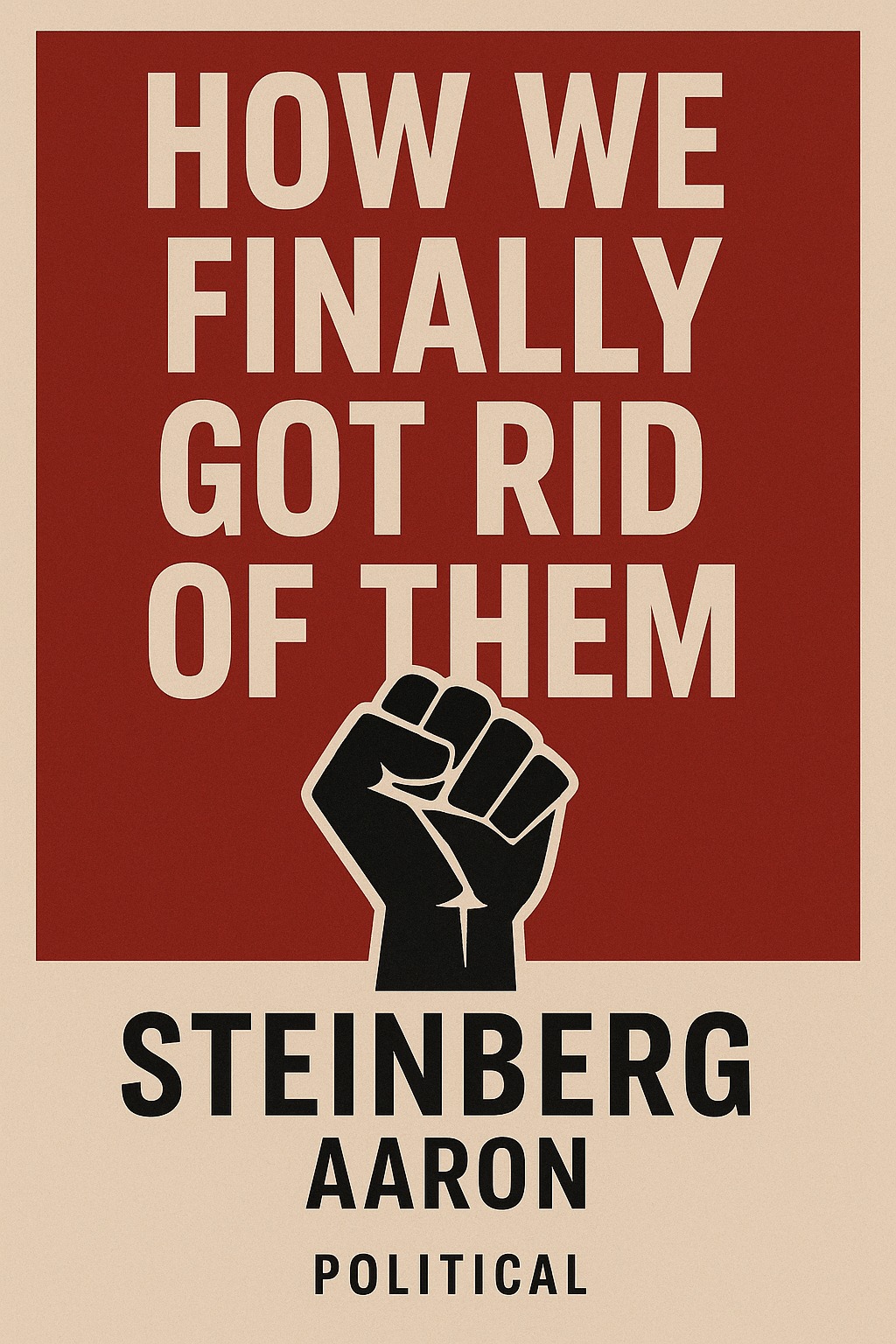
Cover of How we finally got rid of them

How we finally got rid of them

Political · 272 pages · Published 2021-10-05 · Avg 4.3★ (6 reviews)

From chants on the National Mall to sirens outside courthouses in Phoenix and Portland, Americans began asking a question that once sounded unthinkable: Could a country that sent jazz and moon rocks into space slide toward caudillismo? Political historian Aaron Steinberg traces the quiet tools of decline—press 'rebalancing,' bird-shaped gerrymanders, midnight judicial confirmations—across places and decades, from Budapest's Chain Bridge to Ankara's Kızılay and Caracas's Miraflores. Drawing on interviews with county clerks in Maricopa and Wayne and editors from shuttered papers in Youngstown, he shows how democracies wither not with tanks but through budget riders, regulatory capture, and algorithmic floods of disinformation.

The hopeful part is practical. There are exits: codifying emergency norms, funding independent election boards before crises, reviving local news co-ops through antitrust, and forging cross-partisan pacts like those signed in Madison city hall. The bad news is that by normalizing purge lists and leader-worship we missed the first turn. The good news is that countries from Spain after Franco to South Africa after apartheid—and U.S. towns from Birmingham to Boise—left markers. With cases from 1930s Vienna to contemporary Hungary, Turkey, and Venezuela, and the hard lessons of Jim Crow, Steinberg charts how we finally get rid of them—the incentives and enablers of authoritarianism—and how to save what remains, starting with the school board and the zoning map.

Steinberg, Aaron (b. 1983) is a political scientist and civic technologist from Rochester, New York. He earned graduate degrees in public policy and political science and directed the Civic Data Lab at Prairie Lakes University from 2014 to 2020, focusing on institutional resilience, local media ecosystems, and election administration. He has advised nonpartisan municipal associations across the Great Lakes and lives in Chicago, where he volunteers with a neighborhood court-watching program.

Ratings & Reviews

Asha Coleman
2025-09-03

What stuck with me are the voices of clerks and editors, from Wayne to Maricopa, and the blunt, usable steps that make "getting rid of them" mean pruning incentives and repairing institutions rather than waiting for a savior.

Neil Garvey
2025-02-10

If County Lines by T. R. Rangel mapped the bureaucratic sinews of a state and Mira Sokolov's Slow Erosion traced how habits curdle into illiberalism, Steinberg sits between them with more interviews and more practical checklists. It is less polemical than most pundit books and more portable than a political science tome, perfect for city commissioners, school board candidates, and newsroom interns looking to connect global lessons from Turkey and Hungary to a budget meeting on Tuesday night.

Priya Nandakumar
2024-05-21

Read this for the way it reconstructs a civic landscape. You can almost hear the sirens outside courthouses, see the hollowed-out newsrooms in places like Youngstown, and walk the span from Budapest's Chain Bridge to Ankara's crowded squares. The atmosphere is policy-thick but never sterile because it is anchored in streets, desks, and filing rooms.

Most important, the stakes are local and enormous: independent election boards, the dull power of budget riders, the seemingly sleepy zoning map that shapes whether power can be captured quietly. By charting how algorithmic floods warp attention and how cross-partisan pacts can harden norms, Steinberg shows a country-sized system rebuilt from the precinct up.

Jonah Mercado
2023-03-06

A smart piece of political history and civic coaching. Steinberg toggles briskly between Budapest and Phoenix; his chapters alternate diagnosis with remedy. The structure works because each policy tool is paired with a concrete fix, and the recurring interview beats with county clerks create continuity.

The prose has a scholar's bite without the fog. Some transitions feel abrupt when moving from Vienna to contemporary Michigan, and a few concepts show up twice under different headings. Still, the final arc from decline to practical exits holds together and earns its optimism.

Carolina Ames
2022-01-18

I finished this with my pulse up. The question that once seemed unthinkable lands with force here: how a nation that launched jazz and moon rocks could still flirt with caudillismo.

Steinberg names the quiet tools with the precision of a surgeon and the urgency of a street organizer. Press "rebalancing," bird-shaped gerrymanders, midnight judicial confirmations, the algorithmic sewage that drowns attention. He says it plainly, and I underlined it: "not with tanks, but by budget riders and floods of falsehoods."

The book moves from the Chain Bridge to Kızılay to Miraflores and back to the county desks in Maricopa and Wayne, where clerks count envelopes under fluorescent lights. Editors from shuttered Youngstown papers tell you what happens when watchdogs lose funding. It reads like a chorus of places warning the next town over.

And yet the hope is not gauzy. It is a spreadsheet and a calendar. Codify emergency norms before the sirens. Fund independent election boards while it is boring, not when a recount hits. Use antitrust to seed local news co-ops. Sign cross-partisan pacts in city halls like Madison. Yes, yes, yes.

The historical markers from Spain after Franco and South Africa after apartheid to U.S. lessons from Birmingham to Boise keep your eyes up. The last chapters insist on starting where you live, with the school board and the zoning map. That final insistence lit a fire.

Shawn Ortiz
2021-11-09

I learned a lot, but I sometimes felt the middle chapters circled the same pattern.

  • Clear explanation of subtle tactics
  • Repetitive case sequencing
  • Helpful checklists for reform
  • Occasional acronym overload
Generated on 2025-12-28 21:23 UTC