For readers like me, the signal got lost in the static.
- heavy maritime jargon without scaffolding
- repetitive pump-counting and ration math
- fleeting human scenes that never deepen
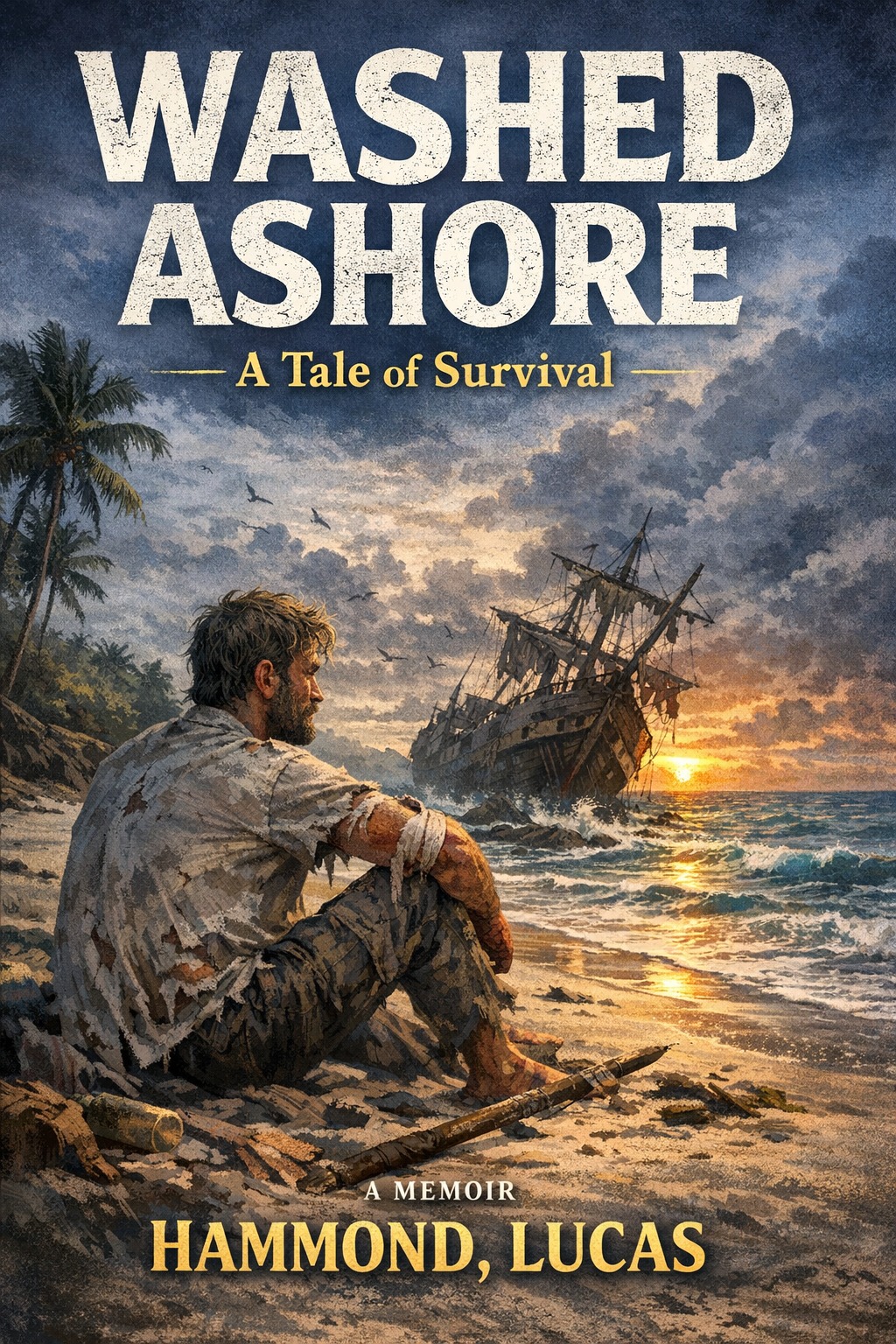
Washed Ashore is Lucas Hammond's clear-eyed chronicle of the hours that stretched into days after he opened his eyes on a basalt-ringed cove on Flores in the Azores, his collapsed orange liferaft snagged in weed and the hand-crank of a salt-streaked desalinator cutting into blistered palms. It is a book of craft and consequence, tracing the quiet arithmetic of survival in the North Atlantic—rationing packets of peanut butter and jerky, tricking gulls with a lure made from a soda tab and monofilament, reading the froth and heave of swells against a jury-rigged sea anchor, and naming the stars again when clouds broke long enough to find Polaris over the black shoulder of Pico.
Hammond carries readers back to what put him on the water at all: a childhood spent on Air Base Road near Lajes Field on Terceira while his mother worked nights as a weather observer, wind humming through guy wires; summers in Galveston where his grandfather taught him to plane cedar for a skiff; his years in Seattle studying oceanography and cartography, then long assignments out of Portland, Maine aboard small NOAA launches, digitizing soundings by headlamp. The sloop Peregrine—rebuilt in a rented garage in South Portland—was supposed to be a careful leap outward, not a bet against a sudden autumn gale spun from the torn edges of Hurricane Nicole.
With candor and an unfussy lyricism, Hammond moves between the brutal mechanics of staying alive—Katadyn pump strokes tallied like prayers, a VHF gone to salt, an EPIRB that fired but drifted out of range—and the quieter reckonings that followed: the knock of a Portuguese Navy corvette alongside near Faial, the first sweet gulp of tea in Horta's Peter Cafe Sport, the long months of physical therapy in Portland, the hum of a dehumidifier in a rented apartment where he relearned sleep. He writes about the people behind the rescue—the coxswain who would only answer to Tavares, a nurse named Madalena who smuggled in oranges—and the slow work of painting Peregrine's name on Horta's breakwater wall next to a sun-faded schooner from Reykjavik. In these pages, survival is not spectacle but practice: a braid of seamanship, stubbornness, luck, and the exact weight of what is lost and carried ashore.

For readers like me, the signal got lost in the static.
For a story so physically intimate, the interiority feels oddly distant. The logbook cadence keeps us on the surface of tasks and timings more than in the ripples of thought.
Tavares and Madalena appear as sketches rather than presences, and the narrator himself often hides behind process. I needed more conversation, more wrestling with fear and aftermath, to balance the admirable seamanship.
Como leitora dos Açores, reconheci o cheiro da maresia e a luz dura nas rochas basálticas. Hammond descreve Flores, o ombro negro do Pico e o cais da Horta com precisão de cartógrafo, sem folclore gratuito.
Os detalhes de ofício dão vida: a âncora de fortuna a segurar o casco, o dessalinizador a morder as mãos, o engodo feito com uma argola de lata para enganar gaivotas, e o primeiro chá no Peter Cafe Sport. Não é espetáculo; é prática paciente de sobrevivência. Quase apetece ir à muralha procurar a pintura do Peregrine.
What a fierce, salt-brined memoir. Hammond wakes on that basalt cove with a collapsed orange raft and blistered hands, and somehow turns the arithmetic of staying alive into a music of attention.
He keeps returning to a mantra: "survival as practice, not spectacle." The Katadyn strokes are counted like prayers, the rationing is humble and precise, the small wins feel luminous.
The juxtapositions stun: Air Base Road's wind in the guy wires, Galveston cedar shavings curling off a plane, NOAA launches lit by headlamps; then back to the black shoulder of Pico, the sea anchor shouldering swells, the old stars renamed after cloudbreaks.
When the Portuguese corvette knocks alongside and later the first sweet tea at Peter Cafe Sport, the relief is almost tidal. The gratitude widens again with the slow work of rehab and the paint drying on Horta's wall.
I closed the book feeling steadied, salt-cured in the best way. This is craft and consequence, stubbornness and grace, carried ashore with both hands!
A trim, exacting piece of life-writing that leans on specificity rather than swagger. Hammond's structure alternates a present-tense survival log with backward glances to Terceira, Galveston, Seattle, and NOAA work, and the hinge points are clean and purposeful.
A few sequences slacken during the rehab months, and the gear talk (lures, sea anchors, EPIRB drift) can stack a little densely; still, the prose keeps a steady cadence, and the closing return to Horta's breakwater ties the book's map of craft and consequence together.
A clear, workmanlike account of survival that sometimes sinks into gear talk but lifts with flashes of Terceira and Galveston memory.