
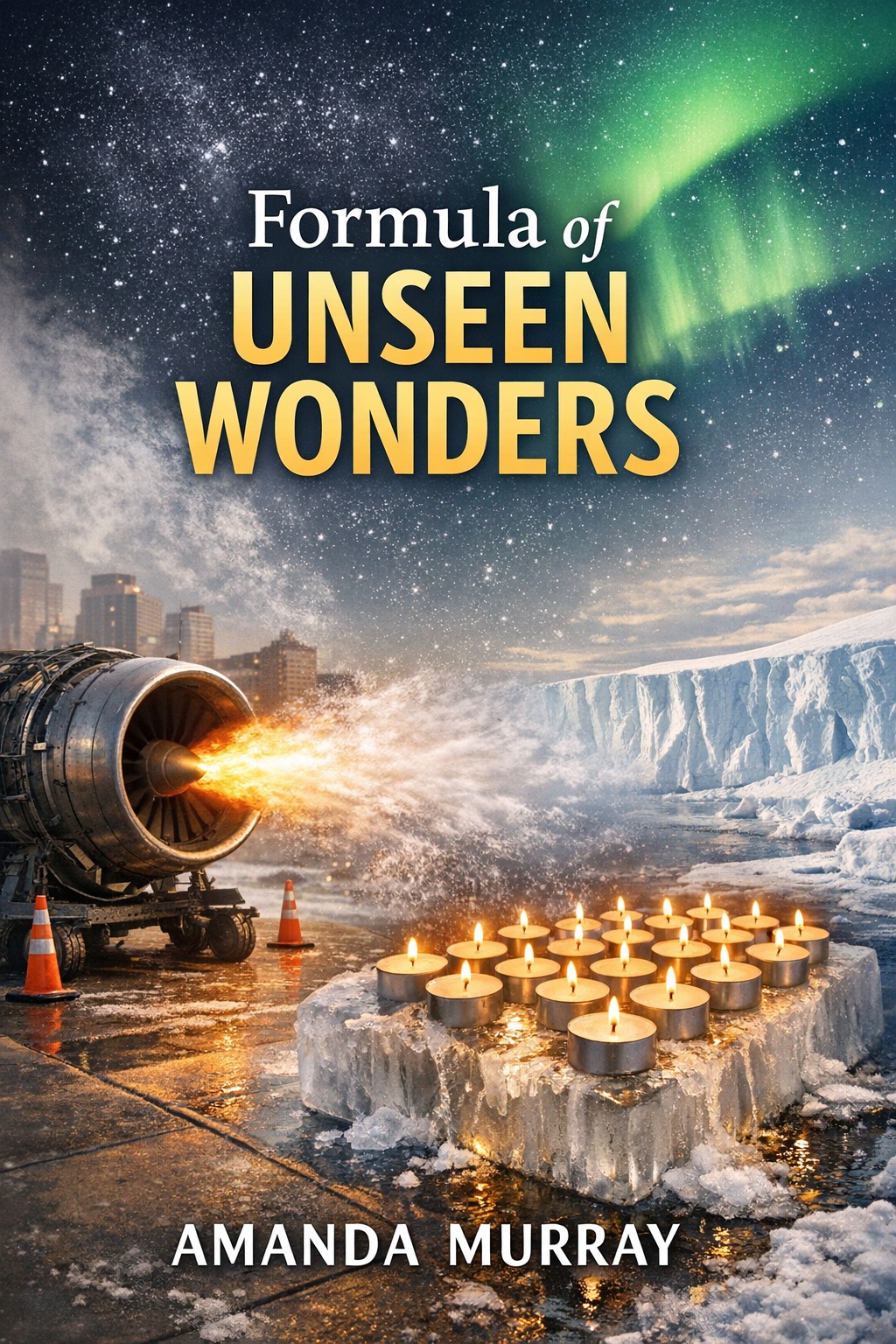
Cover of Formula of Unseen Wonders

Formula of Unseen Wonders

Science · 336 pages · Published 2022-05-10 · Avg 4.2★ (6 reviews)

Curious readers of pop science bombard Dr. Amanda Murray with the kinds of questions that keep lab-safety officers awake: What if you parked a jet engine on a Boston sidewalk to blow away a nor'easter? How many IKEA tealights would melt a hole through the Ross Ice Shelf? Could you synchronize every metronome in Tokyo to tip the Skytree? What happens if a blue whale is teleported into the stratosphere above Nairobi? If every screen in Times Square blasted pure white at noon in July, how much would the city heat up? Murray answers by raiding declassified AEC memos, dusty Air Force handbooks, NOAA buoy logs, and the FORTRAN guts of Monte Carlo models; she calls wind-tunnel techs in Delft, reactor operators in Zaporizhzhia, and storm chasers in Norman, Oklahoma. The results are crystalline, mischievous, and frequently explosive—sometimes literally. With hand-sketched diagrams, sardonic footnotes, and field notes from Kitt Peak, Mauna Kea, and an oil platform off Bergen, Formula of Unseen Wonders turns absurd prompts into guided tours of friction, fluids, heat, and stars. You will leave knowing why pigeons surf pressure waves on the M4 motorway—and why half of our clever schemes end in a spectacular glittering mess over the Mojave.

Amanda Murray, Ph.D., is a Canadian-born physicist and science communicator whose work bridges atmospheric physics and public-interest simulation. Raised in Halifax, she earned a B.Sc. in engineering physics from Queen's University (2006) and a Ph.D. in atmospheric science from MIT (2013), studying aerosol microphysics and urban heat islands. She has collaborated with NOAA and the European Centre for Medium-Range Weather Forecasts, served as a visiting scientist on cooling systems for particle detectors at CERN, and taught fluid dynamics at the University of Washington. Murray writes regular columns for Nautilus and Scientific American, consults for science museums, and leads an independent research studio in Cambridge, Massachusetts focused on open, reproducible modeling. She lives in Somerville, where she keeps two bicycles, an elderly barometer, and an unreasonable number of field notebooks.

Ratings & Reviews

Miguel Arroyo
2025-05-27

Perfect for STEM-curious teens, general readers who like their science leavened with jokes, and book clubs looking for something to spark a wild discussion. The math is approachable, and when it is not, the sketches and analogies carry the load.

Possible cautions include a few explosive scenarios, brief mentions of aviation accidents, and a chapter that imagines large animals in extreme environments. I plan to recommend it alongside hands-on demos about heat and airflow.

Hyejin Park
2024-08-18

Murray treats the physical world as a connected system and lets you feel the network. AEC memos talk to Air Force handbooks, buoy data talks to street heat in July, and a wind tunnel in the Netherlands whispers about skyscrapers in Japan.

The results are oddly beautiful. By the time we reach the blue whale in the stratosphere and the glittering mess over the Mojave, the stakes are not shock but comprehension, a sense that every naive hack runs into the texture of fluids, heat, and crowds.

Gabe Ellsworth
2023-12-02

Fun, but my skeptic side kept tally.

  • Snappy openings on each question
  • Mid-chapter digressions slow momentum
  • Clever diagrams that rescue rough math
  • Closing takeaways land cleanly

Still worth reading for the jet engine and Skytree thought experiments, just not a new favorite.

Priya Menon
2023-04-09

This is the rare pop science book that makes absurdity feel like a laboratory for empathy.

If you like the playful rigor of Chad Orzel and the storm-chasing curiosity of Lee Sandlin, you will feast here. The chapters on metronomes humming across Tokyo and every screen in Times Square blasting white are both comic and clarifying, showing how small frictions accumulate into civic scale. I finished with a new respect for engineers who say no, and for the patient notebooks that make the no persuasive.

Luca Petrovic
2022-10-15

The structure is a clean set of problem essays, each launching with a bonkers prompt and tightening into method. Murray explains Monte Carlo runs and the guts of old FORTRAN in unfussy prose; her hand-sketched diagrams act as signposts when the math gets foggy.

Pacing wobbles in a few chapters where the detours to declassified memos run long, yet the closing sections snap back with clarity. The timing between setup, calculation, and a mischievous coda is usually just right.

Keisha Morin
2022-06-01

Dr. Amanda Murray shows up on the page like a candid lab mate, wry, tireless, and faintly alarmed at our worst ideas. She answers emails to wind-tunnel techs in Delft and reactor operators in Zaporizhzhia with the same curiosity she brings to pigeons surfing pressure waves.

What I loved is the persona she builds through sardonic footnotes and field notes from Kitt Peak and Mauna Kea. Occasionally the voice leans into showy stunts, but the blend of mischief and caution makes the jet engine on a Boston sidewalk feel like a story about responsibility as much as spectacle.

Generated on 2025-12-22 12:03 UTC