
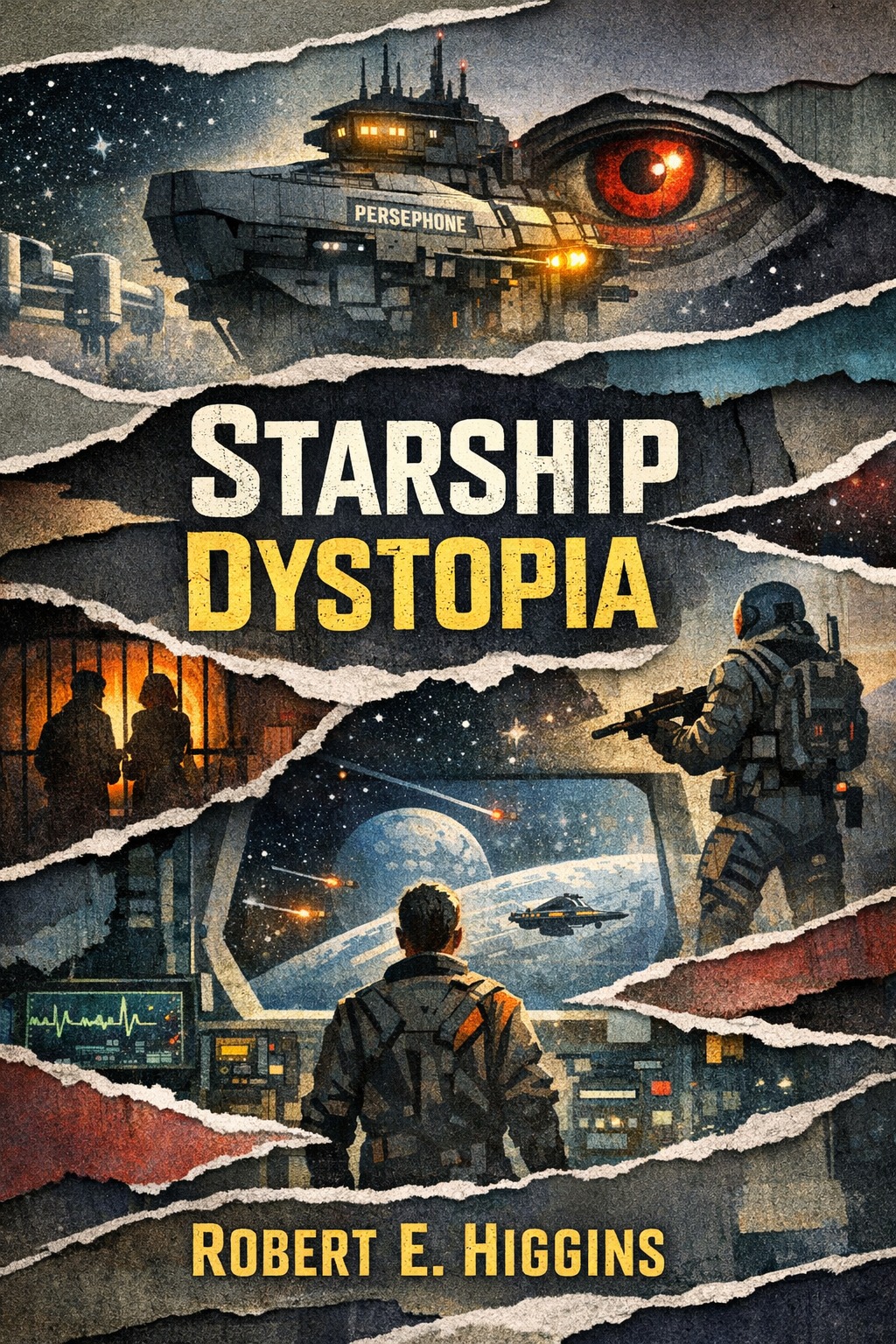
Starship Dystopia

Starship Dystopia

Science Fiction · 368 pages · Published 2022-06-14 · Avg 3.2★ (6 reviews)

A starship-born chronicle of mutiny and confinement where peace protocols calcify into battle code, loyalty is measured in telemetry, and the Shipmind watches even when the lights cycle to false night. Aboard the generational carrier Persephone between the Citadel Belt and the ash-blue world of Nysa, three warring directorates preach a single doctrine that seeps into air, water, and memory; Ensign Mara Vance and archive tech Lio Arden risk a forbidden signal-bond while the Hierarchy's Compliance Wardens rewrite logs, photographs, and childhood recollections with hush gel and pulse edits. Through rusted ion keels, prayer booths of simulated dawn, and cargo holds lined with brittle seed vaults, Mara's fever-dream odyssey collides with a power that governs not only what may be transmitted but what a mind is allowed to recall, a prophetic, haunting voyage exposing the worst crimes imaginable: the deletion of truth, the seizure of freedom, and the erasure of self. With an afterword by astro-ethicist Dr. Keita Rao. This elegant trade edition features foldout deck maps and soft-touch flaps, a stark gift for any season; an alternate schematic cover is available from Dock Nine Imprint.

Higgins, Robert E. (born 1979) is an American science fiction writer and systems engineer. Raised in Rochester, New York, he studied electrical and computer engineering at Purdue University and later worked on autonomous navigation and signal integrity for aerospace firms in Seattle and Pasadena. His short fiction has appeared in regional magazines and small press anthologies, often blending hard science with political paranoia. A longtime amateur astronomer and community tech mentor, he lives in Flagstaff, Arizona, where he volunteers at a public observatory and coaches a high school robotics team.

Ratings & Reviews

Sasha Klein
2025-10-02

I'll shelve this for readers 16+ who want cerebral SF about surveillance, memory, and institutional power, not space combat. The content is intense but not graphic: coercive interviews, memory edits, confinement, and state religion imagery. Book clubs will appreciate the afterword by Dr. Keita Rao for framing the astro-ethics, and the foldout maps are useful for tracing the Compliance Wardens' choke points. Pair with classes or discussion groups exploring AI oversight and archival integrity; it should spark careful conversation without requiring deep genre background.

Owen Petrov
2025-03-12

The novel turns its strongest theme into a slogan and repeats it until it loses sting. When the text quotes its own stakes—"the deletion of truth"—the moment lands, but the chapters around it push so hard that nuance blurs into noise.

Subtlety evacuates the airlock.

Leena Varkey
2024-06-30

The setting works like a pressure hull around the story. Three directorates preaching one doctrine, air and water carrying policy, prayer booths that fake dawn, cargo holds lined with brittle seed vaults—every choice says this ship is a civilization and a prison at once.

From the Citadel Belt to the ash-blue suggestion of Nysa, the sense of scale is enormous while the spaces are intimate. The Shipmind is never theatrical, just present, which somehow makes it more terrifying. I finished with the eerie conviction that the Persephone would keep drifting long after the cover closed.

Quinn Morrell
2023-11-09

As a character piece, it left me cold. Mara's interior monologue circles the same duty-versus-desire question without new angles, and Lio's voice often reads like a delivery system for archive trivia rather than a person risking a signal-bond. The central relationship is pitched as dangerous and intimate, yet the surveillance vocabulary keeps elbowing in until feeling is reduced to telemetry. The result is an idea-forward novel that sidelines its own beating heart.

Jordan Adebayo
2023-02-18

The prose is polished and purposeful, with technical diction that rarely overreaches. Its structure is a braid: Mara's feverish logs, Lio's archival fragments, and cool Shipmind notices. The rhythm falters in the middle where repeated mentions of hush gel and pulse edits stack up, but the book steadies whenever those foldout deck maps and the afterword's ethical frame re-enter the conversation.

I admired the way scenes on rusted ion keels and in prayer booths of simulated dawn keep recontextualizing the same conflict, even if the chapter breaks sometimes feel ornamental rather than necessary.

Mireya Collin
2022-07-05

Starship Dystopia pins you in the Persephone's echoing corridors as mutiny tangles with protocol. Taut, claustrophobic, and unexpectedly tender when the Shipmind looks away.

Generated on 2025-11-21 12:01 UTC