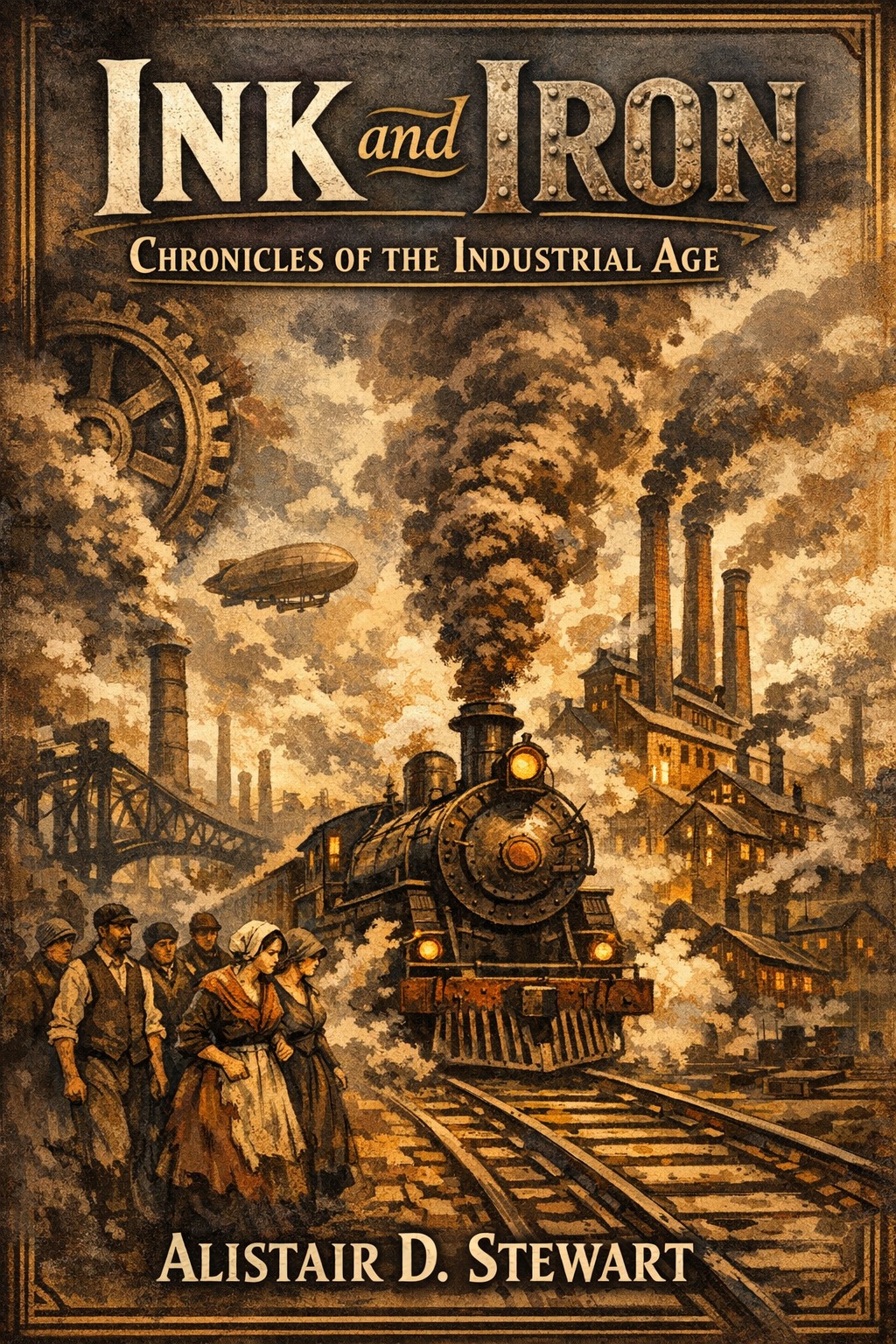
Industrialists boasted that steam and steel would banish hunger and toil forever. The age they built did not last a thousand years; it spanned scarcely a century and a half, yet those decades contained upheavals as cataclysmic as any in modern memory. In the mills of Manchester and Lowell, in Sheffield's glare and along the Monongahela, in the Ruhr's coke-fired valleys and Osaka's shipyards, the Industrial Age fused empires and classes, minted fortunes and miseries, and accelerated time itself. No revolution left such vaults of testimony in its wake: shop-floor time books and pay slips, patent filings and engineering drawings, Blue Books of Parliament, consular dispatches, telegraph logs, insurance inquests, ledgers from the Calcutta jute trade and the Liège gunworks, and the private letters of Brunel, Watt, Stephenson, Bessemer, Carnegie, Krupp, Edison, and Tesla. Before smokestacks toppled or were refitted for electricity, clerks had already numbered the hours and weighed the ore; the world of ink and iron recorded its own making with unsparing detail.
Alistair D. Stewart, a reporter turned historian who has trailed slag heaps and archives from Glasgow to Birmingham, Liège to Silesia, Tokyo to Pittsburgh, spent seven years sifting this documentary mountain. He reads what the paperwork cannot quite say: the brittle discipline of the factory bell and the moments when it failed; the canal age giving way to rails and the rails to copper wire; the grafted sinews of finance binding Lancashire cotton to Mississippi fields and Bombay mills; the bargaining of Meiji planners with British shipwrights; the rivalry of Edison and Tesla mapped against municipal politics and coal prices. He follows outbreaks and consolidations—the Swing Riots and the Tolpuddle transports, the Pullman Strike and the Homestead battle, Ruhr cartels and American trusts—while keeping an eye on the households whose nights were electrified and lungs blackened. The result is a panoramic ledger of power: how energy was smelted, capital concentrated, and the clock colonized.
The analyses of how the United States muscled into steel and oil, how Britain leveraged India and Egypt for cotton, and how Germany's chemists and Japan's Zaibatsu altered the stakes are startling, and the sweep—from early tinkering in Birmingham attics to the gleaming laboratories of BASF and General Electric, and thence to the bottlenecks and conflagrations that converged in 1914—is indispensable reading.