Ink & Pixel: A Sketchbook Tale

Ink & Pixel: A Sketchbook Tale

Comics · 176 pages · Published 2024-06-18 · Avg 3.0★ (6 reviews)

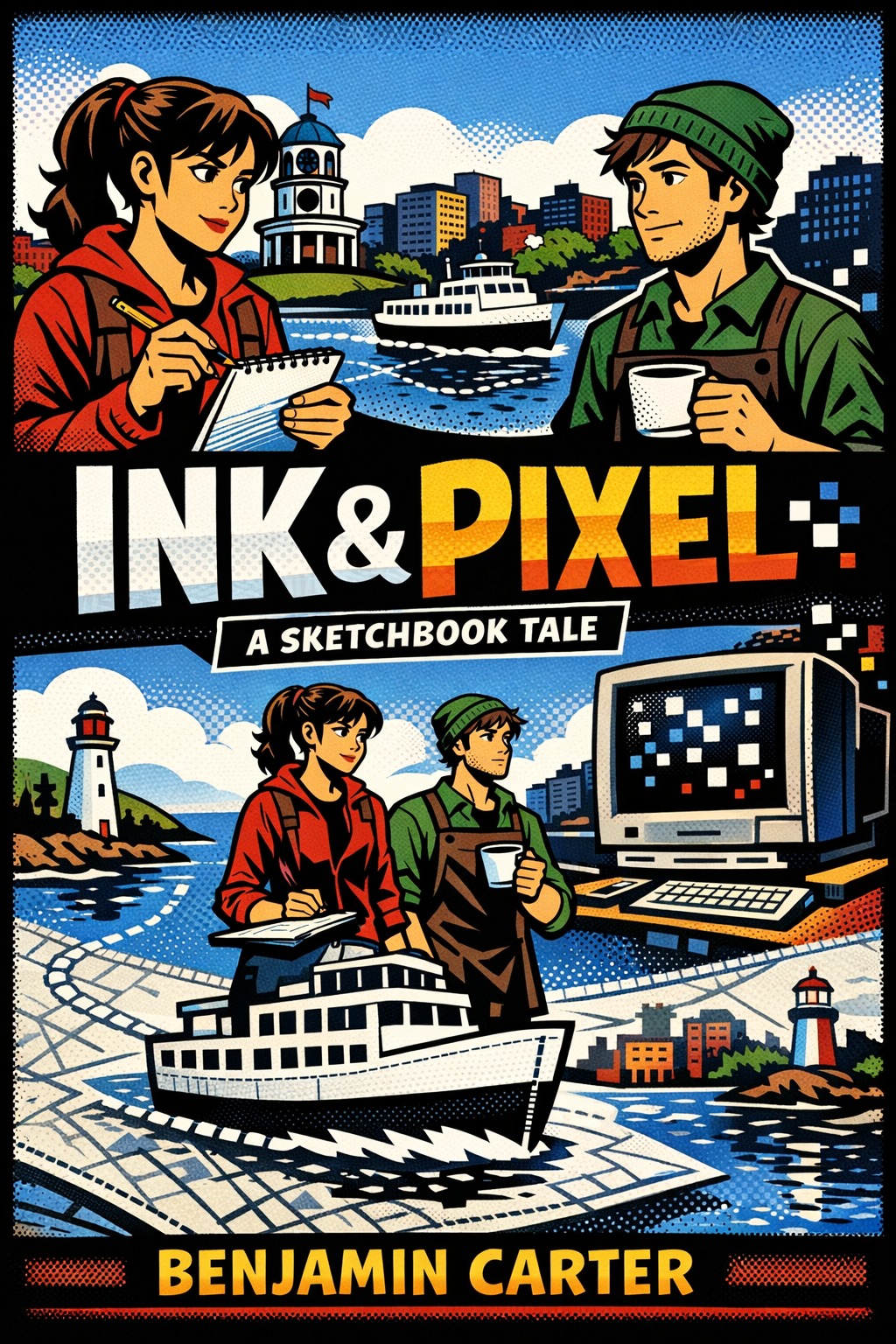
Set in Halifax, this graphic tale maps a city where drawings in a sketchbook alter reality: a penciled ferry route appears in the harbor and pixels hum on a salvaged CRT at the NSCAD print shop. Measured and meticulous, the story follows Mira DeWitt, a municipal cartographer, and Owen Park, a barista-animator, as their routines unravel amid glitching maps and civic panic. Along the way, ideas of authorship and city-making are taken apart as an anonymous editor—signing pages as 'Eff'—redacts panels, shadows them through file rooms, and leaves carbon-paper ghosts in the Halifax Regional Archives.

Benjamin Carter is a Canadian-American writer based in Halifax, Nova Scotia. Born in 1985 in St. Paul, Minnesota, he studied sociology at Carleton University and completed an MFA at the University of British Columbia. His short fiction has appeared in The Fiddlehead, Prism International, and The New Quarterly, and he has received a Nova Scotia Talent Trust grant and a residency at the Banff Centre. Carter has worked as a hospital records clerk, a late-night barista, and a community radio producer, experiences that shape his interest in quiet logistics and place. He teaches part-time at NSCAD University and walks the harbor with a pocket notebook.

Ratings & Reviews

Lena Adeyemi
2025-10-30

From a librarian lens, the audience for this is narrow. It leans on art school ephemera, municipal jargon, and meta editing tricks that my general readers tend to bounce off.

Good candidate for academic collections tied to visual studies or urban planning. For public shelves, I would flag archival anxiety, surveillance vibes, and citywide unrest, with no gore but steady unease. Most teens in our comics club would likely disengage before the payoffs land.

Noah Tremblay
2025-06-21

The city-making here is half civics, half enchantment, and the balance is intriguing. Pencil marks reroute ferries, CRTs thrum with artifacted light, and municipal processes grind forward while everyone wonders who is in charge of the map. The rules feel mostly consistent, although a few reality shifts arrive with less groundwork than I wanted, and the sense of stakes sometimes fades under the cool conceptual sheen. Still, Halifax feels like a system you could live inside, not just a backdrop.

Marta Ochoa
2025-03-05

Mira reads like someone who actually calibrates instruments for a living. She speaks in measured notes and small, wry observations, and her steadiness makes the stranger turns feel plausible. Owen bounces ideas off everything around him, from steam wands to harbor light, and their dialogue has the cozy rhythm of coworkers who have closed up together more than once.

Eff is a presence more than a face, an editor whose pressure shapes their choices rather than a simple antagonist. That dynamic lets the warmth between Mira and Owen flicker through the static, and by the end I believed in their bond as much as I believed in the sketchbook.

Ravi Deshmukh
2024-12-15

The visual grammar is meticulous, with thin gutters and a restrained palette, but the rhythm is choppy; Eff's gray edits interrupt beats that were building. Whole sequences in the print shop feel stranded between concept sketch and finished page, and the archival inserts repeat their gesture one time too many.

Elliot Ng
2024-09-02

Cool idea, patient pacing, and a Halifax that feels lived in, but the stop-start redactions kept tugging me out of the story just as the maps began to glitch.

Sierra Gauthier
2024-07-10

I finished this with salt-air in my lungs and toner in my throat. Ink & Pixel radiates that wonky Halifax weather where a sunbreak can turn into a fog siren in five panels, and I loved every minute of its strange, generous heart.

The book promises "a city where drawings in a sketchbook alter reality" and then keeps finding new ways to test that promise. A penciled ferry route quietly becomes a commute, pixels start humming on a salvaged CRT in the NSCAD print shop, and the city starts asking who gets to draw the lines that everyone must live by.

Mira DeWitt is steady, precise, deeply municipal in the best way, and Owen Park brings jittery curiosity and ink-stained charm. As their routines unravel, maps stutter, coffee cups shake, and the streets tilt toward panic. Through it all, Eff redacts and annotates, shadows them through file rooms, and litters the Halifax Regional Archives with carbon-paper ghosts that feel like fingerprints left on a living document.

This is a book about authorship and stewardship, about the ethics of drawing maps and the responsibilities of editing them. It asks whether redaction can be care, whether a city can be co-authored without erasing the people who already live there, and it does so with wit, tenderness, and just enough static to keep your spine buzzing.

I am thrilled by how it argues for public imagination as a public good. Five stars, because it made the ordinary bus stop feel like a drafting table and convinced me that a careful pencil can rewrite a harbor without sinking a single boat.

Generated on 2025-11-13 12:03 UTC