
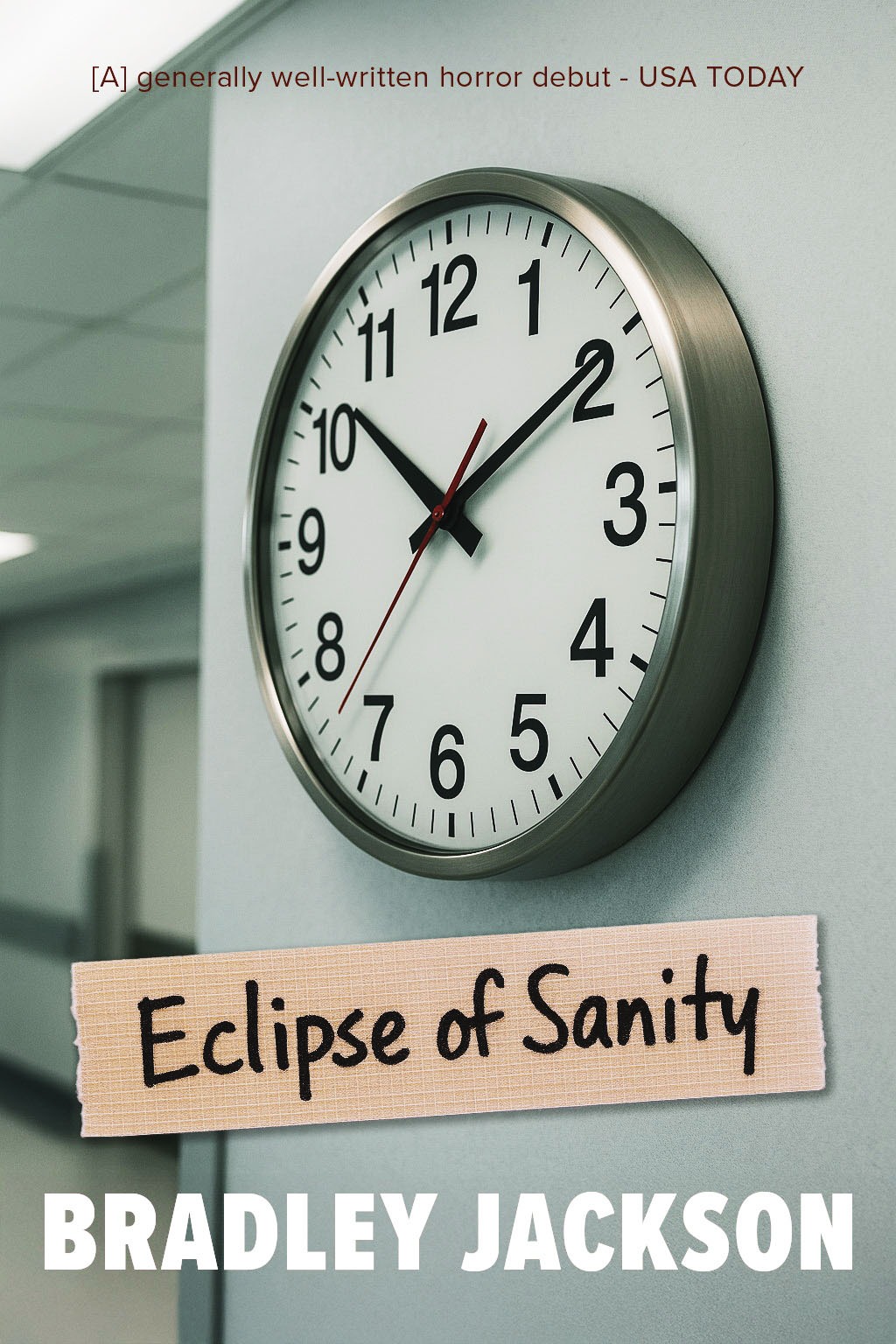

Cover of Eclipse of Sanity

Eclipse of Sanity

Horror · 336 pages · Published 2023-10-31 · Avg 2.3★ (6 reviews)

Graduate nurse Lena Morrow is spending the graveyard shift on Blackbridge State Hospital's sealed Eclipse Ward, a lightless wing beneath the bell tower in Lakeport, Michigan. She has dreaded this rotation since the incident in Room 614, a secret she hid with a forged chart and a broken wristwatch. As the hours drag and the generator stutters, the intercom coughs with voices that do not match the census, elevator C opens to a corridor the floor plan omits, and the med-room clock keeps resetting to 10:10.

When the security tech in the glass booth stops answering and call lights bloom over empty beds, Lena understands patients and staff are vanishing. The only clue is surgical tape folded into crescents and a brass key stamped QUINE, the disgraced founder. As doors lock and badges fail, it becomes clear everyone inside Eclipse Ward is in grave danger. Lena's worst fear was returning to the East Annex for one night. Now the siren outside wails for a town that cannot hear them, and she might never reach the last set of steel doors.

Photo of Bradley Jackson

Bradley Jackson is a Midwestern horror writer born in 1984 in Dayton, Ohio. He studied biology at Ohio University and worked nights as a hospital unit clerk before earning an MFA from the University of North Carolina Wilmington. A former EMT and volunteer crisis-line counselor, he draws on medical settings and rust-belt folklore to craft claustrophobic, slow-burn tales. His short fiction has appeared in small-press magazines, and his novella Cold Storage won the 2019 Rust Lantern Prize. He lives in Grand Rapids, Michigan, where he teaches community writing workshops and hikes the dunes with a stubborn rescue beagle.

Ratings & Reviews

Deja Whitcomb
2025-07-03

Blackbridge State Hospital feels half-mapped and half-dreamed, a subterranean wing under a bell tower where badges die, cameras blink snow, and an elevator opens to nowhere the blueprints admit. The atmosphere is palpable, but the rules of the place — why the key matters, what the crescents signal, how the ward seals — stay so slippery that the stakes soften instead of sharpening.

Mireille Chen
2025-01-12

This should have been a razor about institutional neglect, but the blade keeps sliding.

The motif choices are promising: crescents of surgical tape, the bell tower like a metronome for harm, a brass key bearing a disgraced name. They point to an eclipse of ethics, to systems that wink the lights and call it protocol.

And then the book ducks its own shadow. Scenes arrive in a fog, themes wave from somewhere down Elevator C, and the signal gets lost in the generator cough.

Those "call lights over empty beds" moments ought to land like indictments, yet they feel ornamental because the narrative refuses to say what, precisely, is being covered up. I kept waiting for the moral torque to bite; it skittered away.

By the fifth return to 10:10 my frustration peaked, not from fear but from a sense of squandered aim. Horror can be chaotic, yes, but chaos with purpose burns; here it flickers.

Jordan Mbaye
2024-10-30

Lena's conscience is the most compelling thing in the building. The forged chart and the broken wristwatch promise a study of guilt, yet her interior monologue oscillates between checklist and panic, rarely cracking open into anything specific. Dialogue lands with clinical efficiency, not revelation, and when people vanish the book seldom lets her process it beyond a new task. I wanted more of her past with the East Annex so the present night would cut deeper.

Tomas Ibarra
2024-05-20

Reads like Brian Evenson wandering the service tunnels of a shuttered psych ward, with a touch of Gemma Files in the interference on the intercom. If you enjoy claustrophobic single-location horror and can forgive a murky throughline, this is a decent midnight diversion. If you need answers spelled out, the Eclipse Ward may leave you checking your own wristwatch.

Anika Duarte
2024-02-15

Lena's night is organized around a ticking conceit: the clock that keeps resetting to 10:10. The short, urgent chapters catch the fluorescent buzz and the rattle of a failing generator, but the syntax leans on sentence fragments so often that momentum blurs. I liked the recurring objects — the brass key stamped QUINE, the crescents of tape — as structural signposts, yet the timeline corkscrews without enough anchoring, and the intercom voices drift in like radio static rather than purposeful threads. It works scene to scene, less so as a whole.

Caleb Morton
2023-11-02

Bleak hospital horror that mistakes repetition for dread; the hour snaps back to 10:10, Elevator C opens on a corridor the map forgot, and my patience drained faster than the generator.

Generated on 2025-08-17 22:30 UTC